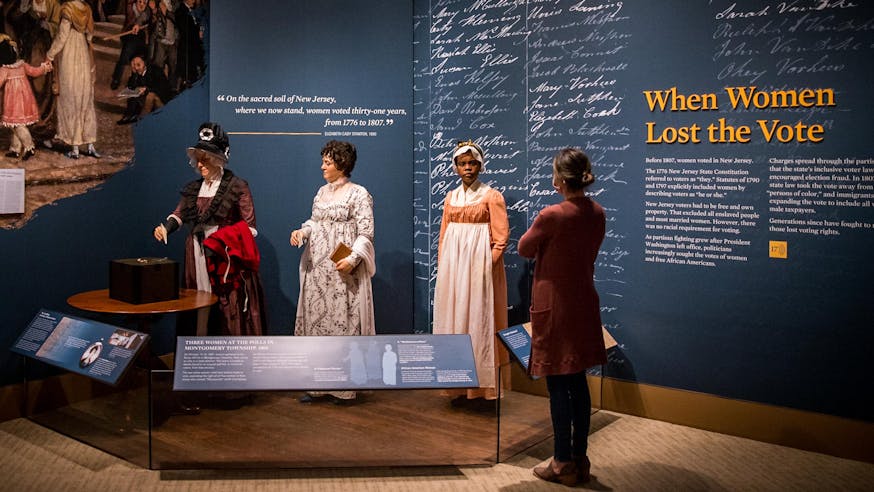


When Women Lost the Vote
When Women Lost the Vote Glossary
The following definitions may be useful as you explore the When Women Lost the Vote Teacher Resources, Big Ideas, and Primary Sources. Print or download the PDF for even easier access as you explore.
abolition
The act of officially ending a system, practice, or institution. Most often used in reference to the movement to end slavery.
abolitionist
A person who advocates for the ending of a system, practice, or institution. Most often used in reference to the movement to end slavery.
Alien & Sedition Acts
A set of four laws passed by a Federalist-controlled Congress and signed into law by President John Adams in 1798. These laws, which were heavily influenced by the Quasi-War with France, tightened restrictions on foreign-born Americans and limited speech that criticized the government. Democratic-Republicans and their supporters were largely targeted by these laws.
amendment
An official change. Most often used in reference to changes in the Constitution.
ballot
A way to cast votes. Typically, ballots are a piece of paper with a vote written or marked on it.
Black Codes
A series of laws passed in Southern states to restrict the rights of Black people after the Civil War. These laws were typically modeled after former Slave Codes.
clause
A specific section within a law or legal document.
coverture
A legal practice that held that married women were legally covered by their husbands and that they were not independent legal agents. This practice restricted married women’s rights, as they had no legal, political, or economic authority or identity separate from their husbands. In contrast, single women could own property, make and sign contracts, serve as heads of households, and own and operate businesses.
Democratic-Republicans
An American political party that formed in opposition to the Federalist Party. Founded and most notably led by Thomas Jefferson and James Madison. They supported individual liberties, the rights of states, and an economy based on agriculture.
discriminate/discriminatory
To treat a person or group of people unfairly based on the group they belong to.
disenfranchise
To deprive or take away the right to vote.
dowry
An amount of property or money the bride or her family brought into the marriage. Upon marriage, it would belong to the husband, and typically a woman regained their dowry upon her husband’s death. This was typically considered the daughter’s inheritance.
English Common law
These laws are based on customs and court decisions rather than formal legislation, and they were used to fill in the gaps left by written law. They were never collected into an official legal code. English common law originated in England during the Middle Ages and was used by English colonies.
Enlightenment
An intellectual movement during the 17th and 18th centuries that believed human reason and learning could help improve society. It sparked developments in art, science, philosophy, and politics, including the idea that government could be run by the people rather than a monarch. Also called the Age of Enlightenment.
enslaved
Owned by another person. Saying “enslaved person” rather than “slave” can remind people of the humanity of the person who is in the condition of being owned by another person.
estate
Total property or possessions owned by a person living or dead.
Federalists
The Federalists were an early American political party led, most notably, by Alexander Hamilton. Federalists supported a loose interpretation of the Constitution, a strong central government and National Bank, and an economy that focused on industry rather than agriculture. They were political opponents of the Democratic-Republican Party.
gender roles
Behaviors society considers to be appropriate for specific genders.
grandfather clauses
These clauses allowed voters whose grandfather could vote to be able to vote without needing to take a literacy test or pay a poll tax. They were passed by several Southern states during the Jim Crow era and designed to allow white voters while still restricting Black voters (many of whose grandfathers had not been able to vote).
indentured servants
Individuals who signed contracts to serve as laborers for a specific amount of time before receiving their freedom. These contracts were sometimes entered into willingly by British subjects who wanted passage across the Atlantic Ocean to the British colonies but could not afford it themselves or by those — Europeans, free people of African descent — who needed food, shelter, clothing, and the opportunity to learn a skill. In other cases, British subjects were sentenced to indentured servitude as punishment for a crime or because they could not pay their debts. Forced removals of people from their lands in the British countryside drove the growth of cities in Britain itself and helped fill ships with new servants for America.
interracial
Involving people of different races.
Related PDF

legislature
An organized group of people who make laws to govern a community, state, or country. Sometimes referred to as the Legislative Branch of government.
literacy tests
Tests that were supposed to assess a person’s ability to read and write in order to vote. However, many tests were impossible to pass and only the issuer of the test could say whether a test was passing. Some issuers would grade the test more easily or provide an easier test for white voters.
natural rights
The idea that all people are born with certain rights, and those rights cannot be taken away by anyone, including the government.
norms
Society’s standard behaviors or expectations.
partisan
Strong support for a specific party, usually without considering the matter carefully.
petticoat
A woman’s skirt worn during the 18th century.
poll taxes
A tax that voters must pay in order to vote.
popular sovereignty
Rule by the people.
preamble
The beginning of a document that states its purpose.
Quakers
Members of the Religious Society of Friends. Quakers were pacifists, and during the Revolutionary War, many refused to join or support the war. During the American Revolution, many began to join abolitionist movements.
ratified
To sign or give formal approval to a treaty, constitution, contract, or agreement to make it official.
republic/republican
A democracy where the head of state and representatives are elected by the people.
stereotype
A societal assumption or expectation about a group of people. It is typically believed that the assumption or expectation applies to every person in that group.
suffrage
The right to vote in an election.
suffragist
A person who advocates for the extension of the right to vote. Often used in reference to supporters of the Women’s Suffrage Movement.
temperance
To refrain from drinking alcohol or to control or moderate a specific behavior.
widow
A woman whose husband has died. She typically inherits something from her husband’s estate, and she regains the rights of single women to own property, make and sign contracts, serve as heads of households, and own and operate businesses.
__________________________________________________________________
This glossary was created for the When Women Lost the Vote Teacher Resources in order to align with the national standards. There is a When Women Lost the Vote online exhibit glossary that matches the content found in that online exhibit.
Learn More

When Women Lost the Vote Teacher Resources

When Women Lost the Vote Big Ideas