

Banners of Liberty
Thirteen Stripes, One Union: The Story of Two Revolutionary War Flags From Philadelphia
May 30, 2025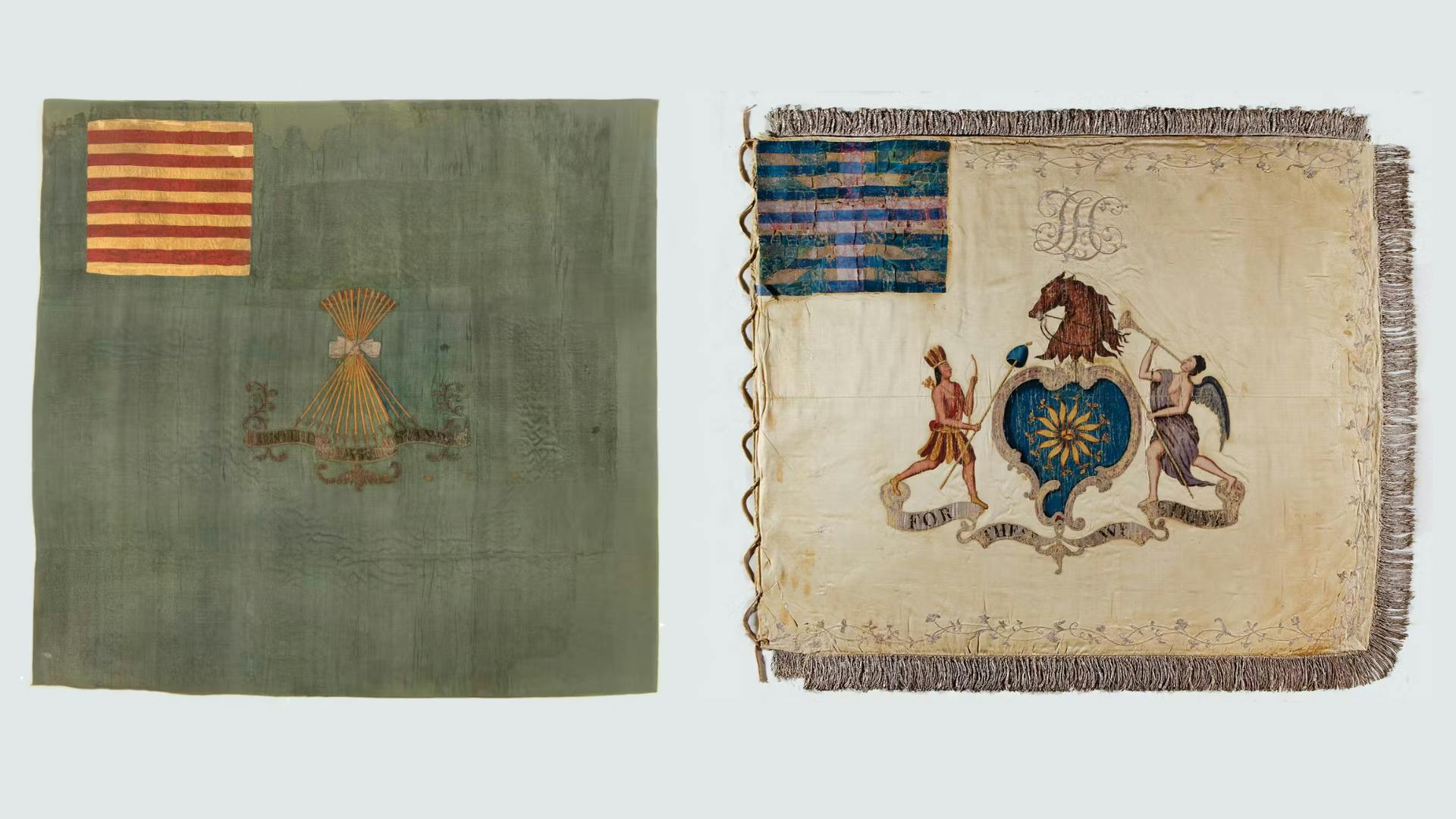
The Museum of the American Revolution’s Banners of Liberty exhibition brings together the largest gathering of Revolutionary War flags since 1783. These flags tell many stories – of the battles they were carried in, of the people who marched or rode under them, and of the people who made them. They also reveal the story of changing feelings about the new nation being fought for. Two of the flags in the exhibition – those of the 1st Pennsylvania Battalion and the Light Horse of the City of Philadelphia– demonstrate this shift in attitudes. They also both originated right here in Philadelphia.
The 1st Pennsylvania Battalion began in 1775. More than 500 men marched from Philadelphia to Canada, attempting to take Montreal and Quebec from the British. They were ultimately unsuccessful, one of the Battalion’s young officers, Josiah Harmar, went on to serve throughout the Revolutionary War, including as a staff officer of George Washington. After the 1st Pennsylvania Battalion disbanded, Harmar came into possession of its flag; Banners of Liberty marks the first time that it has returned to Philadelphia since the war. In the center of the flag are thirteen arrows bundled together, and the motto “United We Stand,” both symbols of the spirit of the new nation coming together. Its canton, in the upper-left corner, was originally the British union. During the course of the war, as the idea of a new nation separate from Britain took hold, the canton was replaced with thirteen red and white stripes to represent the new United States.
Similarly, the canton of the Light Horse of the City of Philadelphia’s Standard began as the British union but was repainted with thirteen stripes after the adoption of the Declaration of Independence in 1776. A cavalry unit, the Light Horse of the City of Philadelphia likely carried this flag during the Battles of Trenton and Princeton; taking part in the famous crossing of the Delaware, they were instrumental in the victory at Trenton, as well as at Princeton. The Light Horse of the City of Philadelphia still exists, today known as the First Troop of Philadelphia City Cavalry, and they have served both in international conflicts and domestic roles in the centuries since the Revolution. They also maintain a museum, and have preserved all of their flags, including the original, which has been loaned for Banners of Liberty.
Like the 1st Pennsylvania Battalion Flag, it uses symbols representing the unity of the thirteen united states. In the center of the flag, below a horse, are thirteen ribbons knotted together, while on the left a Native American, representing North America, carries a pole with a liberty cap and wears thirteen feathers. On the right is an angel with a trumpet, signifying victory, fame and the consequences that the founders hoped their actions would have. Markoe spared no expense with this flag, having it made from imported materials like silk and silver braid. To learn more about the Light Horse of the City of Philadelphia flag, watch this interview with Dennis Boylan, former Commander of the First Troop of Philadelphia City Cavalry:
Flags that are carried into battle serve multiple purposes – they are easy to spot on a crowded and chaotic battlefield, and their mottoes and symbolism give troops something to rally behind. They also can serve those of us looking at them after the fact, even centuries later, by showing us what people believed in as they carried these flags into battle. They even show us how those beliefs changed, as with the cantons of the flags 1st Pennsylvania Battalion and the Light Horse of the City of Philadelphia, which were painted over as revolutionaries shifted from angry British subjects to citizens of a new nation. These two flags also give us tangible pieces of Philadelphia’s military history from its earliest beginnings, and with the Light Horse, a clear link from the past to the present.
Learn More

Banners of Liberty: An Exhibition of Original Revolutionary War Flags
April 19 - August 10, 2025
Flag Day & Father's Day Weekend 2025 at the Museum
June 14-15, 2025