

Read the Revolution
Jefferson's Daughters
June 4, 2025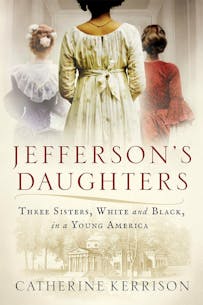
While the founders argued that “all men are created equal,” people’s lives and freedoms in the 18th century were circumscribed by their race, gender, and class. Historian Catherine Kerrison underscores this in her book, Jefferson’s Daughters: Three Sisters, White and Black in a Young America. This composite biography explores the three daughters of Thomas Jefferson who lived to adulthood – Martha and Maria, whose mother was Jefferson’s wife, also named Martha, and Harriet Hemings, whose mother Sally was enslaved by Jefferson. By combining these three stories, Kerrison contrasts the thorough education and privileged upbringing of Martha and Maria with the very different experiences of Harriet. She also illuminates the lives of the other people enslaved at Jefferson’s home at Monticello by contrasting the relative ease of Harriet’s life with those of others around her.
Jefferson’s Daughters uses the stories of these three women to illuminate the larger world and attitudes of the time. Jefferson’s daughter Martha’s elite education in France, the women’s marriages and family lives, and even the architecture of Monticello tell a broader story about 18th-century society. The vastly different relationships that Thomas Jefferson, often remembered as an author, president, and statesman, had with each of his daughters reveal much about him as a person and how he balanced revolutionary ideas with the realities of his family life.
Related Content

Excerpt
Jefferson had now buried his wife and five of the six children born of his marriage. His admission of his searing pain was a rare view into his interior landscape, revealed only to a much-trusted friend. But as he looked up from his letter, surveying his bleak future, his vision failed him, editing out completely the little son and daughter who were growing up on Mulberry Row. Martha was not his only surviving child. By 1804, Sally Hemings had borne him five children, two of whom still lived: Beverley, six, and Harriet, three. And before he left Monticello to return to Washington that dark spring, he and Hemings would conceive another child, Madison, as Jefferson fought the specter of death that threatened to overwhelm him.
Although born into slavery, Sally Hemings’s children lived very differently from the hundreds of other slaves Thomas Jefferson owned over the course of his lifetime. First and foremost, they knew they were destined for freedom. The perpetuation of slavery required that enslaved children be trained in habits of submission to their masters, even as their parents attempted to raise them as individuals within their own community of family and friends. Harriet was spared the brunt of the tensions most enslaved children endured as they were caught between these cross-purposes. Jefferson did not embrace Harriet as his third daughter, but neither did he train her for a slave’s life.
With next to no documentation of her childhood, we must cobble together a picture of Harriet’s world from a variety of sources: Jefferson and the overseers he employed, accounts from former Monticello slaves, and the stories that Jefferson’s grandchildren would later tell to preserve his legacy as a beneficent slave owner. These records need to be scrutinized carefully, particularly because the subject of Jefferson and slavery has been so very contentious. Nonetheless, they can be quite useful in helping us understand the larger world of slavery on Jefferson’s plantations and the place of the Hemingses within it, and to imagine what it was like for Jefferson’s enslaved daughter to grow up knowing that one day she too could live her life in the pursuit of happiness.
Catherine Kerrison, Jefferson’s Daughters: Three Sisters, White and Black in a Young America (New York, NY: Penguin Random House, 2019), 189-190.
Learn More
A New Nation
Core Exhibition
Revolutionary Women