

Read the Revolution
In Dependence
February 26, 2025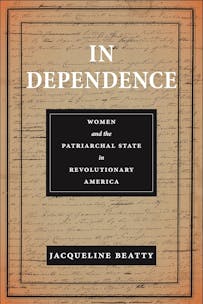
Purchase the book from NYU Press.
The fight for women’s rights began long before the 19th Amendment was passed in 1920. In March 1776, Abigail Adams implored her husband, John Adams, to “Remember the Ladies” as he and the other men of the Continental Congress worked to enshrine the laws of a new government. From 1776 until 1807, women and free people of color held the right to vote in New Jersey thanks to the state’s own radical constitution – a right that was later revoked and then reserved for only white men. All the while, female activists in many cases were still constrained by the stereotypes, laws, and tropes of their society. From the Revolutionary era to today, as norms have changed, activists have ensured the promise of the American Revolution endures by fighting for equal rights for all people.
In In Dependence: Women and the Patriarchal State in Revolutionary America, author Jacqueline Beatty uses examples of 18th-century women like Adams and Elizabeth Graeme Fergusson, who realized the limitations their gender placed on them in early American society, especially their dependence on the men in their lives for economic, legal, and livelihood protection. And yet these women carefully manipulated femininity to exert their own power and agency in other ways. When Fergusson’s secret marriage to Loyalist Henry Fergusson and his subsequent disappearance led to financial ruin and the confiscation of her family estate, she petitioned the Pennsylvania Supreme Executive Council for its return and “employed tropes of feminine helplessness and vulnerability” in a careful appeal to the council’s sympathy. Other women leaned on societal expectations of them as mothers and caregivers to secure benefits and protection for themselves.
In this excerpt from the introduction, Beatty explores how women used contemporary conceptions of femininity to exert their own agency and how the forms of women’s social dependence were also influenced by race and class.
Related Content

Excerpt
American women in the revolutionary era like Elizabeth Graeme Fergusson knew well the terms of their multifaceted dependencies. Despite enormous legal, social, and economic restrictions, however, early American women were far from powerless. How is it, then, that these women with few rights under the law (and restricted access to the political sphere) were able to express power? During and after the Revolution, women’s petitions to the patriarchal state—the colonial, revolutionary, and early national institutions, organizations, and spaces governed and controlled by elite white men—increased exponentially. The consequences of war provided both the impetus and the opportunity for women to seek intervention from male authorities in their communities and at the state level. In their increased interactions with the patriarchal state, women employed the very terms of their intersectional dependencies as a strategy to exert agency over their own lives. Significantly, too, the American Revolution provided some women with the language and opportunities with which to claim old rights—the rights of dependents—in new ways. Paradoxically, then, early American women were able to negotiate and argue for a relative degree of power, independence, and rights from the patriarchal state because of, and while they existed firmly within, this state of dependence.
Sign Up
Get biweekly Read the Revolution featured excerpts right to your inbox.
Historians have spent decades investigating whether the American Revolution benefited women or provoked changes in women’s status. By and large, white women’s traditional political rights and legal status remained relatively stagnant in the wake of the American Revolution. In some ways, women’s legal status declined over the course of the long eighteenth century. Certain women’s private lives, however, did see some important shifts, especially in regards to family limitation and motherhood. Importantly, the Revolution politicized some women who participated in boycotts, contributed to and consumed Tory and Whig literature, and even acted as spies or soldiers themselves during the war. Women also carefully negotiated their political positions to manage the survival and safety of their families. In the postwar period, elite white women gained greater access to education, though ultimately in service of raising respectable republican sons and their worthy wives. In many ways, however, the lives of American women looked much the same in the postrevolutionary period as they had prior to the war. Despite Abigail Adams’s threat to “foment a rebellion” if women were not included formally in the new American body politic, there would be no great women’s revolution in the late eighteenth and early nineteenth centuries.
Asking whether the Revolution benefited women or brought meaningful changes in their social, legal, and economic statuses, however, cannot fully illuminate the war’s impact on women’s lives. In some ways, this framework is both anachronistic and problematic. Constructing our queries in this way asks too much from a historical period in which inequality and unfreedom were so deeply embedded in patriarchal law, culture, and society as to render such a sea change unlikely at best. Likewise, this line of inquiry presumes that revolutionary-era women collectively desired what first- and second-wave feminists sought for themselves. It also judges the consequences of the Revolution for women from a set of expectations codified as masculine. Certainly, there were a few noteworthy women who sought rights and freedoms for which liberal feminists of the nineteenth and twentieth century fought, but the Abigail Adamses, Mercy Otis Warrens, and Judith Sargent Murrays of the American revolutionary era were few and far between.
Jacqueline Beatty, In Dependence: Women and the Patriarchal State in Revolutionary America (NYU Press, 2023), 5-6.
Learn More
Women's History Month
When Women Lost the Vote: A Revolutionary Story: Discovering America’s First Women Voters, 1800 - 1807