

Read the Revolution
Don Troiani’s Black Soldiers in America’s Wars, 1754–1865
February 12, 2025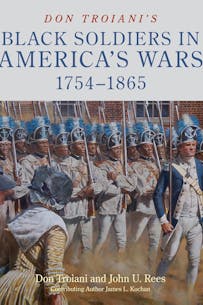
Purchase the book from Barnes & Noble.
The Revolutionary War began almost 250 years ago at the Battles of Lexington and Concord in Massachusetts on April 19, 1775. Among the hundreds of Minutemen who took the field that day were at least 35 men of African descent. For the rest of the Revolutionary War, soldiers of color fought on both sides of the conflict. In historical artist Don Troiani and historian John U. Rees’s new book, Don Troiani’s Black Soldiers in America’s Wars, 1754-1865, we have the chance to see what these soldiers may have looked like as they fought in regiments from around the world and in all theaters of the war.
This excerpt explores just the first battles of the war, but Troiani and Rees’s book includes vivid illustrations depicting battle scenes and individual soldiers. Troiani’s individual “figure studies” show us soldiers of African descent in the Rhode Island Regiment, the Havana Battalion of Free Blacks, the Hessen-Hanau Artillery, and many other units.
Excerpt
Black Americans were in the fight from the first. Massachusetts militia men of color, free and enslaved, fought alongside their white comrades from Lexington to Concord, and back to Boston, on April 19, 1775. To date we have the names of thirty-five Black men present that day, at least eighteen seeing combat: one, Prince Estabrook, was wounded while with Captain John Parker’s company on Lexington Green. John Hannigan notes that, given incomplete records, it is likely that as many as forty to fifty African Americans were with the militia on the war’s first day. Another was twenty-six-year-old Cuff Whittemore, slave to William Whittemore. A 1907 history of Arlington, Massachusetts, recounted an eyewitness account from April 19:
Cuff was on the hill with the Menotomy militia [under Capt. Benjamin Locke]. . . . Solomon Bownan was lieutenant, and on the opening of the fight at that point . . . [Whittemore] acted cowardly, and in his alarm turned to run down the hill. But the lieutenant threatened to shoot him with a horse pistol, and pricked him in the leg with the point of his sword. This brought Cuff to his senses and the negro “about facing” fought through the contest, as the colonel [Ebenezer Thompson] said, like a wounded elephant, making two “cuss’d Britishers” bite the dust.
At the end of the day’s action Lieutenant Frederick Mackenzie, British 23rd Regiment of Fusiliers, noticed another Black participant. “As soon as the troops had passed Charlestown Neck the Rebels ceased firing. A Negro (the only one who was observed to fire at the Kings troops) was wounded near the houses close to the Neck, out of which the Rebels fired to the last.”
Sign Up
Get biweekly Read the Revolution featured excerpts right to your inbox.
Two months later, at least eighty-eight Black and fifteen Indian soldiers are known to have served at the Bunker Hill battle; one historian estimates the total may have been as high as 150, roughly 5 percent of American troops involved. Cuff Whittemore had enlisted in the newly formed New England army on June 4, 1775, and fought at Bunker Hill two weeks afterward. An 1826 book included this passage:
[Whittemore] fought bravely in the redoubt. He had a ball through his hat . . . fought to the last, and when compelled to retreat, though wounded, the splendid arms of the British officers were prizes too tempting for him to come off empty handed, he seized the sword of one of them slain in the redoubt, and came off with the trophy, which in a few days he unromantically sold.
Another soldier, Salem Poor, stands out among the many involved in the Bunker Hill battle. He was lauded for his actions that day, and honored in a testimonial signed by Colonel William Prescott, commander of the Bunker Hill redoubt, and thirteen officers from five different regiments. The document was addressed to “The Honorable General Court of the Massachusetts Bay” and reads:
The Subscribers beg leave, to report to your Honble House, (which wee do in justice to the Caracter of So Brave a Man) that under Our Own observation, Wee declare that A Negro Man Called Salem Poor of Col Fryes Regiment Capt Ames Company in the late Battle at Charlestown, behaved like an Experienced officer, as Well as an Excellent Soldier, to Set forth Particulars of his Conduct Would be Tedious, Wee Would Only beg leave to Say in the Person of this . . . Negro Centers a Brave & gallant Soldier. The Reward due to So great and Distinguisht A Caracter, Wee Submit to the Congress ___ Cambridge Decr 5th 1775
Don Troiani and John U. Rees, Don Troiani’s Black Soldiers in America’s Wars, 1754-1865, 15.
Learn More
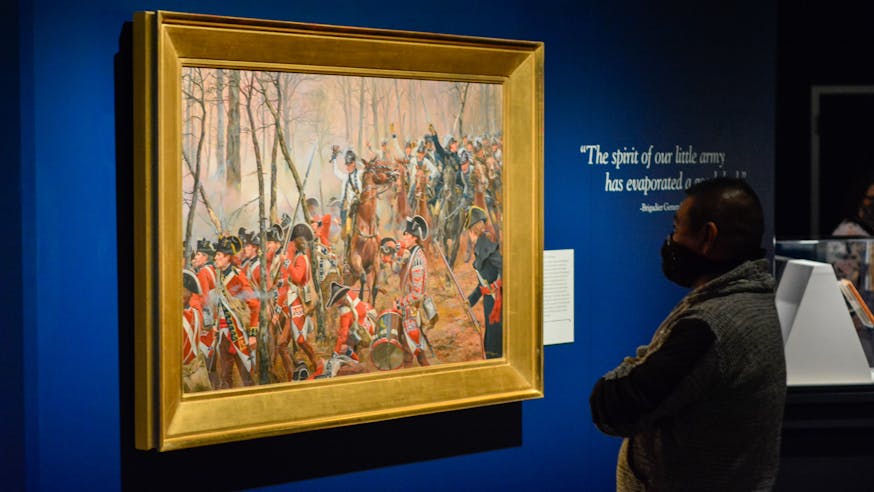
Liberty: Don Troiani’s Paintings of the Revolutionary War
October 16, 2021 - September 5, 2022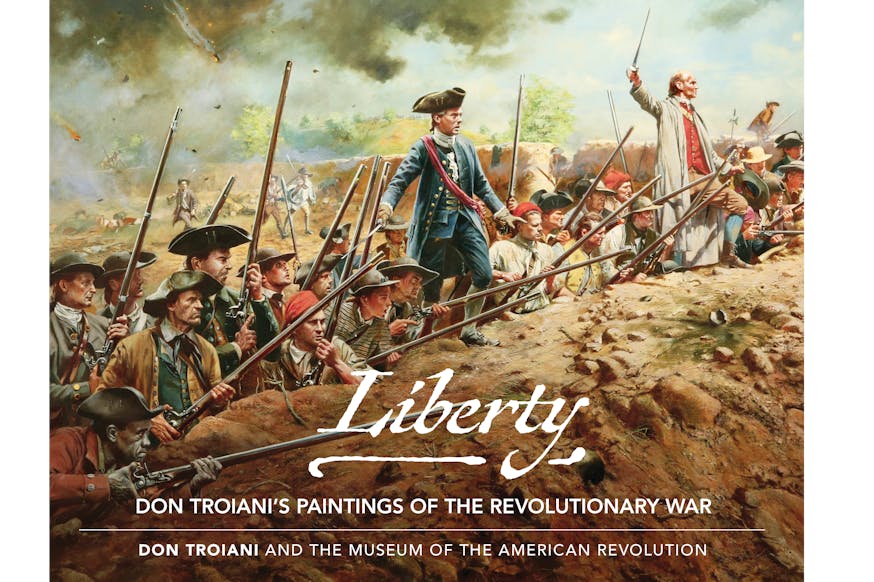
Liberty