

Read the Revolution
Common Sense / Thomas Paine and the Promise of America
January 7, 2026
Purchase Common Sense from Abe Books.
Purchase Thomas Paine and the Promise of America from MacMillan Publishers.
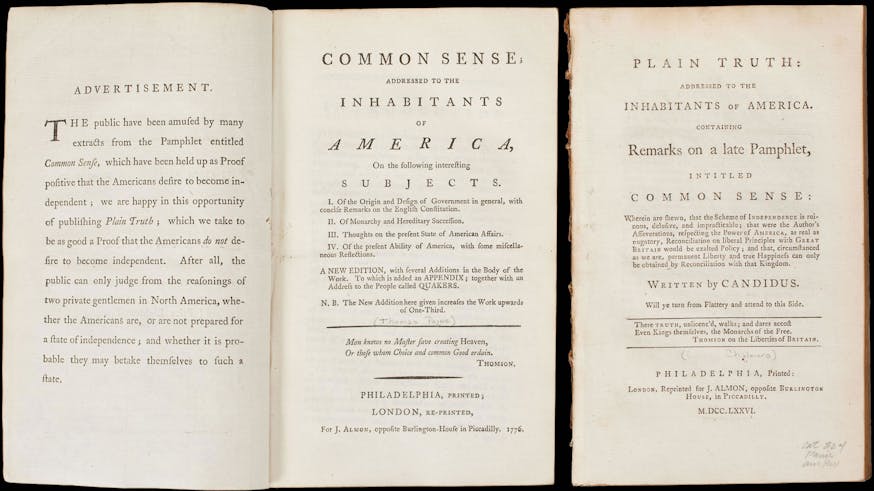
250 years ago, on Jan. 9, 1776, Thomas Paine’s incendiary pamphlet, Common Sense; Addressed to the Inhabitants of America, “burst from the press with an effect which has rarely been produced by types and paper in any age or country,” in the words of a contemporary. It was a runaway bestseller that changed the course of American history. As author Harvey J. Kaye calculates in Thomas Paine and the Promise of America, were its 1776 sales inflated for today’s population, it sold the equivalent of 15 million copies, placing it among the bestselling books in all of American history. A slim 80 pages in its first edition, Paine’s work did more than any other piece of writing to convince some Americans that the only solution to their grievances with British government was a radical, treasonous new path: independence.
On this anniversary, read a short excerpt from Kaye’s biography of Paine, and then sample Common Sense itself. The excerpt here is perhaps the most famous portion of Paine’s work, and you might be surprised to know that it was not in the first edition. Paine added it in an appendix that appeared a month later, and it was in this addition that he welcomed the “birth day of a new world.”
Related Content

Excerpt from Thomas Paine and the Promise of America
The lawyers, merchants, landowners, and planters who debated in the Continental Congress and the colonial assemblies argued spiritedly and often radically. The classes they represented would effectively direct the American Revolution. Yet if history had had to wait solely upon their deliberations, the rebellion might never have become a war for independence. Even if it had, by the time they got around to proclaiming the United States of America, it might well have been too late. And likely it would never have become the world-history-shaping event that it did.
America’s working classes—farmers, mechanics, laborers, seamen, servants, and slaves—would make the American Revolution a revolution. They would not realize all their dreams, but they would power the struggle, materially, martially, and politically, indeed, at a most crucial moment, literally. The Declaration of Independence, though drafted by a Virginia aristocrat and edited by a committee of colonial gentlemen, issued from the force of Common Sense, authored by an immigrant workingman who would proudly describe himself as a “farmer of thoughts.”
“The cause of America made me an author,” Thomas Paine said. It also made him a revolutionary. Emerging from the working classes, he had come to believe that they too, not just the titled and propertied, could live as citizens, not merely subjects. What he discovered and witnessed in America—especially the mobilization of mechanics and laborers and the formation of committees to enforce colonial resolutions—convinced him of it: “I was struck with the order and decorum with which everything was conducted; and impressed with the idea, that a little more than what society naturally performed, was all the government that was necessary, and that monarchy and aristocracy were frauds and impositions upon mankind.”
Paine saw all of history turning on the outcome of the American colonies’ conflict with Britain. Yet he worried that Americans themselves might not adequately perceive what was at stake. “The independence of America would have added but little to her own happiness, and been of no benefit to the world,” Paine wrote, “if her government had been formed on the corrupt models of the old world. It was the opportunity of beginning the world anew…of bringing forward a new system of government in which the rights of all men should be preserved that gave value to independence.”
Paine’s originality in Common Sense remains a contentious question. Some scholars have presented Paine as a truly innovative political thinker. A greater number, deferring to the assertion by the ever-envious John Adams that Paine merely restated what Adams and others had previously advanced in the Continental Congress, have found Paine’s originality not in his ideas but in his craft as a writer. They variously celebrate Paine for developing a radically new literary style, creating a new political grammar, and bequeathing so many “memorable lines” to American letters. And still a few others, while acknowledging Paine’s momentous influence, have denied him credit for anything really novel at all.
Paine himself—for all his reputed bravado and boastfulness—never professed to have invented either a new set of political principles or a new political rhetoric. He had no doubt about the importance of his labors and did not hesitate to remind others of them, claiming “the honest pride” of “ranking myself among the founders of a new Independent World.” But he repeatedly averred that the originality lay within Americans themselves. In contrast to revolutions elsewhere, “here the value and quality of liberty, the nature of government, and the dignity of man, were known and understood, and the attachment of the Americans to these principles produced the Revolution, as a natural and almost unavoidable consequence.” He would probably have agreed with the Vermont minister who said, “Paine, and other writers upon American politics met with amazing success: Not because they taught the people principles, which they did not before understand, but because they placed the principles which they had learned of them, in a very clear and striking light, on a most critical and important occasion.”
Paine underestimated his own originality, but he grasped the originality of American life. And inspired by it, he would make Americans aware of themselves as Americans, a people possessed of exceptional purpose and promise and capable of creating a free, equal, and democratic nation-state that would become “an example to the world.”
Kaye, Harvey J., Thomas Paine and the Promise of America (New York: Hill and Wang, 2005)
Sign Up
Get biweekly Read the Revolution featured excerpts right to your inbox.
Excerpt from Appendix to Common Sense
I shall conclude these remarks, with the following timely and well intended hints. We ought to reflect, that there are three different ways, by which an independancy may hereafter be affected; and that one of those three, will one day or other, be the fate of America, viz. By the legal voice of the people in Congress; by a military power; or by a mob: It may not always happen that our soldiers are citizens, and the multitude a body of reasonable men; virtue, as I have already remarks, is not hereditary, neither is it perpetual. Should an independancy be brought about by the first of those means, we have every opportunity and every encouragement before us, to form the noblest purest constitution on the face of the earth. We have it in our power to begin the world over again. A situation, similar to the present, hath not happened since the days of Noah until now. The birth day of a new world is at hand, and a race of men, perhaps as numerous as all Europe contains, are to receive their portion of freedom from the event of a few months. The relaxion is awful and in this point of view, how trifling, how ridiculous, do the little, paltry cavillings, of a few weak or interested men appear, when weighed against the business of a world.
Paine, Thomas, Common Sense (Philadelphia: R. Bell, 1776)
Learn More
The Road to Independence
Core Exhibition
Season of Independence