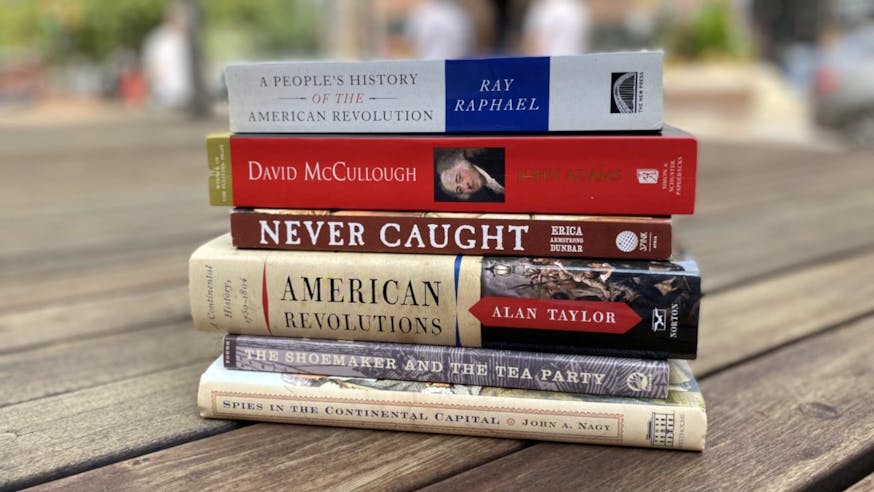


Read the Revolution
The Unknown American Revolution
December 18, 2024
Purchase the book from Penguin Random House.
History is not just about facts; it’s also about investigation and interpretation. There’s always more to learn about the American Revolution. These ideas underpin the Museum’s interpretive philosophy across everything we do, from our award-winning core galleries to our robust online educational resources.
The same beliefs are also at the heart of late historian Gary B. Nash’s seminal work, The Unknown American Revolution: The Unruly Birth of Democracy and the Struggle to Create America. Nash’s “bottom up” approach to history shifts the focus of the historian’s lens to the lives and actions of everyday people. The American Revolution, he argues, was radical in that it “put power in the people.” American independence was far from inevitable. The people – who Nash calls the “life and soul” of the Revolution – included free and enslaved people of African descent, Native Americans who found themselves with split allegiances, religious leaders, “backcountry farmers, urban craftsmen, deep-blue mariners, female camp followers, and food rioters.” These different groups did not all agree on a single vision for the burgeoning country, but during the exhilarating and messy years of the Revolutionary era, they laid down the ideals that are part of both our inheritance and ambitions toward which we still strive today. The people who lived, labored, struggled, and sacrificed during this time sparked an experiment in liberty, equality, and self-government that is still ongoing.
Read an excerpt from the introduction where Nash, who was a founding member of the Museum’s board of scholars, lays out his argument for readers to look beyond traditional “founding father” historical narratives to appreciate the “ideas, dreams, and aspirations” of the diverse people whose lives, stories, and legacies highlight the “true radicalism of the American Revolution.”
Related Content

Excerpt
“Truth always makes sad havoc with the frostwork of the imagination and sternly demands the homage of the historian's pen.”
- Benson Lossing, Pictorial Field-Book of the American Revolution (1850)
“Who shall write the history of the American Revolution? Who can write it? Who will ever be able to write it?” Thus wrote John Adams in 1815 to Thomas Jefferson, his old enemy but by this time his septuagenarian friend. “Nobody,” Jefferson replied from Monticello, “except merely its external facts... The life and soul of history must be forever unknown.”
Not so. For more than two centuries historians have written about the American Revolution, striving to capture the “life and soul” of which Jefferson spoke. We now possess a rich and multistranded tapestry of the Revolution, filled with engaging biographies, local narratives, weighty explorations of America's greatest explosion of political thinking, annals of military tactics and strategies, discussions of religious, economic, and diplomatic aspects of what was then called the “glorious cause,” and more. Indeed we now have possession of far more than the "external facts."
Yet the great men – the founding fathers – of the revolutionary era dominate the reigning master narrative. Notwithstanding generations of prodigious scholarship, we have not appreciated the lives and labors, the sacrifices and struggles, the glorious messiness, the hopes and fears of diverse groups that fought in the longest and most disruptive war in our history with visions of launching a new age filling their heads. Little is known, for example, of Thomas Peters, an African-born slave who made his personal declaration of independence in early 1776, fought for the freedom of African Americans, led former slaves to Nova Scotia after the war, and completed a pilgrimage for unalienable rights by shepherding them back to Africa to participate in the founding of Sierra Leone. Why are the history books virtually silent on Dragging Canoe, the Cherokee warrior who made the American Revolution into a two-decade life-sapping fight for his people's life, liberty, and pursuit of happiness? We cannot capture the “life and soul” of the Revolution without paying close attention to the wartime experiences and agendas for change that engrossed backcountry farmers, urban craftsmen, deep-blue mariners, female camp followers and food rioters, those ordinary people who did most of the protesting, most of the fighting, most of the dying, and most of the dreaming about how a victorious America might satisfy the yearnings of all its peoples.
Sign Up
Get biweekly Read the Revolution featured excerpts right to your inbox.
In this book the reader will find, I hope, an antidote for historical amnesia. To this day, the public remembers the Revolution mostly in its enshrined, mythic form. This is peculiar in a democratic society because the sacralized story of the founding fathers, the men of marble, mostly concerns the upper-most slice of American revolutionary society. That is what has lodged in our minds, and this is the fable that millions of people in other countries know about the American Revolution.
I ask readers to expand their conception of revolutionary American society and to consider the multiple agendas the stuff of ideas, dreams, and aspirations that sprang from its highly diverse and fragmented character. It is not hard today to understand that American people in all their diversity entertain a variety of ideas about what they want their nation to be and what sort of America they want for their children. Much the same was true two centuries ago. But from a distance of more than two centuries we don't think about our nation's birth that way. It is more comforting to think about united colonists rising up as a unified body to get the British lion's paw off the backs of their necks. That is a noble and inspiring David and Goliath story, but it is not what actually happened. It is assuredly not the story of radical democracy's work during the Revolution.
This book presents a people's revolution, an upheaval among the most heterogeneous people to be found anywhere along the Atlantic littoral in the eighteenth century. The book's thrust is to complicate the well-established core narrative by putting before the reader bold figures, ideas, and movements, highlighting the true radicalism of the American Revolution that was indispensable to the origins, conduct, character, and outcome of the world-shaking event.
By “radicalism” I mean advocating wholesale change and sharp transformation rooted in a kind of dream life of a better future imagined by those who felt most dissatisfied with the conditions they experienced as the quarrel with Great Britain unfolded. For a reformed America they looked toward a redistribution of political, social, and religious power; the discarding of old institutions and the creation of new ones; the overthrowing of ingrained patterns of conservative, elitist thought; the leveling of society so that top and bottom were not widely separated; the end of the nightmare of slavery and the genocidal intentions of land-crazed frontiersmen; the hope of women of achieving a public voice. This radicalism directed itself at destabilizing a society where the white male elite prized stability because it upheld their close grip on political, economic, religious, sexual, and social power. This radicalism, therefore, was usually connected to a multifaceted campaign to democratize society, to recast the social system, to achieve dreams with deep biblical and historical roots, to put “power in the people,” as the first articles of government in Quaker New Jersey expressed it a century before the American Revolution.
Gary B. Nash, The Unknown American Revolution: The Unruly Birth of Democracy and the Struggle to Create America (Penguin Random House, 2006), XIII-XV.
Learn More
Plan Your Visit

Remembering Gary Nash