



Read the Revolution
The Memory of '76
January 8, 2025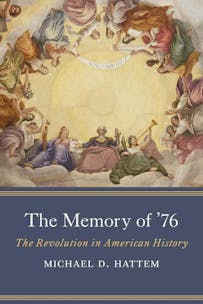
Purchase the book from Yale University Press.
What would the American Revolution mean after the Revolutionary generation passed away? This was a new challenge. In a country based on ideas and not birthrights, who would inherit the Revolution? How would the Revolutionary era be defined and remembered by future generations? From the 1770s, through the Civil War, to today, people have reflected on the Revolutionary War in their efforts to create and preserve historic sites, influence civil rights movements, form new political parties and agendas, inspire popular culture, and manage international affairs.
In his latest book, The Memory of ‘76: The Revolution in American History, historian Michael D. Hattem presents a history of the changing relationship between the people and the Revolution as we approach 2026 and the 250th anniversary of the signing of the Declaration of Independence. Citing presidents, writers, artists, political organizers, historic institutions, and ordinary Americans, Hattem explores how generations have told the story of the Revolutionary War’s events and how politics have shaped the way the Revolution is remembered.
Read an excerpt from The Memory of ‘76 to learn why, in the middle of the American Civil War, two artists and a minister were separately inspired to use the latest technology to photograph the last living Revolutionary War veterans. Now recreated as a display in the final gallery of the Museum’s core exhibition, these photographs allow visitors and students to look into the eyes that witnessed the Revolutionary War.
Excerpt
At the height of the Civil War in 1864, Americans learned that only twelve remaining revolutionary veterans were still collecting pensions when Congress passed a highly publicized law increasing their benefit. Nelson and Roswell Moore – two brothers from Connecticut and early adopters of the first form of photograph – the daguerreotype – became interested in the veterans after reading reports of the new law. They tried to find and contact each of the remaining veterans to preserve their likenesses and to make some money by selling prints. By the time they began their search, half of them had already passed on. The Moore brothers tracked down six veterans and traveled to Maine, New York, and Ohio to photograph them. At the same time, Elias Hillard, a Yale-educated Connecticut minister, also became interested in the veterans. He too tracked the six men down and took down their life stories.
Sign Up
Get biweekly Read the Revolution featured excerpts right to your inbox.
We do not know the specifics of how the Moore brothers and Reverend Hillard found each other, but they did. The Moore daguerreotypes were combined with Hillard’s accounts of their lives in The Last Men of the Revolution, published in 1864 as the Civil War raged. Hillard wrote that “every American desires to know all that can be known of the surviving soldiers of the Revolution.” He was keenly aware that “the present is the last generation that will be connected by living link with the great period in which our national independence was achieved.” After that and forevermore, “the American Revolution will be known among men by the silent record of history alone.” The book’s hazy, sepia tone lent the images a haunting, ethereal, otherworldly quality. Readers were able to behold the likenesses of men whose eyes had witnessed the Revolution, who had seen George Washington commanding the Army, the horrors of Valley Forge, and the surrender of Cornwallis at Yorktown. Hillard hoped his book would serve as a salve by reminding Americans, North and South, of the common heritage they shared. But throughout the antebellum and Civil War eras, the memory of the Revolution would be an important tool for the nation as it tried to pick up the pieces of civil war and begin casting itself onto the world stage in the new century.
Michael D. Hattem, The Memory of ’76: The Revolution in American History (Yale University Press, 2024), 94-95.
Learn More

Read the Revolution Speaker Series with Michael D. Hattem
January 23, 2025, at 6:30-7:30 p.m.
Past and Prologue
