

Read the Revolution
The Fate of the Day
April 23, 2025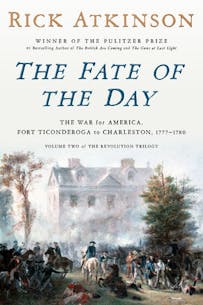
Purchase the book from Penguin Random House.
In The Fate of the Day: The War for America, Fort Ticonderoga to Charleston, 1777-1780, Pulitzer Prize-winning author Rick Atkinson continues the dramatic tale in the second volume of the Revolution Trilogy, tracing battles fought at Brandywine in 1777 to Charleston in 1780. General George Washington is only one of many Revolutionary leaders characterized in Atkinson’s second volume, which presents viewpoints from an exhausted Continental Army to a determined King George III to emphasize the American commitment to the struggle for freedom and demands of democracy. Timed to coincide with the 250th anniversary of the start of the Revolutionary War this year and complete with detailed battle maps, the book includes illustrations of artwork by Xavier Della Gatta and William B. T. Trego in the Museum’s collection.
Atkinson had concluded his bestselling first volume, The British Are Coming: Lexington to Princeton, 1775-1777, in January 1777, when Abigail Adams reflected on the war to her friend, Mercy Otis Warren, “...Our late misfortunes have called out the hidden excellences of our commander in chief,” and, along with other Revolutionaries, predicted that General George Washington’s leadership in the struggle ahead would be a key to securing American independence.
Excerpt
“The road had surely been rough for these two years, with some five hundred military and naval engagements, and more than eight thousand American casualties. American ambitions had changed markedly from Lexington and Concord, from a demand to be fully British in rights and privileges to not being British at all but, rather, a free, independent people. What form this new entity should take was still uncertain, as seen in the many metaphors used to describe the United States: a flight of birds, a flock of sheep, a swarm of fish, or, as depicted on the Continental six-dollar bill, a beaver gnawing down a large tree. Some Americans thought of themselves as an alligator, a wildcat, a swam of angry hornets, or a coiled rattlesnake. Loyalists suggested that the insurgency instead resembled a mongrel dog, a long-eared ass, or a zebra with thirteen stripes, each named for a state, with troublesome Massachusetts at the rump.
Whatever the nation would become, the army must be the transformational agent in the ascent from colonial backwater to sovereign power. Rebellion still streamed from a thousand pulpits and a hundred printing presses, but precisely how to convert that defiance into a war-winning military philosophy remained elusive. This was the essence of Washington’s mission. When he later ordered busts of prominent generals to decorate Mount Vernon, he chose the likes of Alexander the Great and Julius Caesar, audacious, risk-taking commanders celebrated for their battlefield brio. Yet these two years of combat had forced him to restrain his intrinsic, swashbuckling aggression and to move with unwonted caution.
His Excellency now believed that the struggle was existential, not only for the United States but also for Britain. “Her very existence as a nation depends now upon her success,” he had written to a friend in April [1777]. “For should America rise triumphant in her struggle for independency, she must fall.” That made the enemy all the more dangerous: this would be a fight to the death. He also knew that his generalship must be as politically savvy as it was militarily sound; hence those hundreds of letters to Congress, state officials, committees of safety, and others vital to shoring up the cause and supporting the army.
... Of the roughly two hundred thousand American men who would bear arms in the patriot cause, about half served in the Continental Army and half in militia regiments manned by part-time citizen soldiers. More than seven hundred skirmishes during the war would be fought by militiamen alone. They also gathered intelligence, set ambushes, guarded prisoners, and served as a partisan constabulary, intimidating Crown loyalists and coercing the uncommitted.
Washington never stopped carping about the militia, which he considered unreliable and poorly trained, with officers often pulled from “the lowest class of people, and instead of setting a good example to their men and leading them into every kind of mischief.” But he had grudgingly come to acknowledge that militia regiments were “more than competent to all the purposes of defensive war.” This month [August 1777] he would even praise their “spirit and fortitude.” Defeating the British Empire, however, required a professional, permanent army, competent indeed to every contingency. Building such an insuperable force continued to occupy his every waking hour on the Little Neshaminy.”
Rick Atkinson. The Fate of the Day: The War for America, Fort Ticonderoga to Charleston, 1777-1780. (New York, NY: Crown, 2025)
Learn More

The British Are Coming
The Darkest Hour
Core Exhibition