

Read the Revolution
Suffering Soldiers
December 11, 2024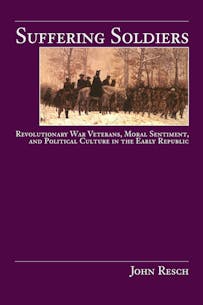
Purchase the book from University of Massachusetts Press.
John Resch’s Suffering Soldiers: Revolutionary War Veterans, Moral Sentiment, and Political Culture in the Early Republic discusses how the status and treatment of Revolutionary War veterans changed over time. Resch examines how veterans, initially viewed as symbols of national sacrifice, became central to debates on moral obligations and political identity. Using Peterborough, New Hampshire, as a case study, Resch traces the experiences of veterans through the post-war period and highlights the increasing tensions between the ideals of a new nation and the circumstances confronted by soldiers who had sacrificed so much to secure that nation’s independence.
Resch highlights how veterans struggled for recognition and compensation in an era when public and political opinions often emphasized self-reliance over entitlement. He argues that the growing sympathy for the “soldiers of ‘76” following the end of the War of 1812 helped reshape public attitudes toward veterans. The portrayal of veterans as “suffering soldiers” coupled with the “groundswell of nostalgia for the Revolution that swept the country in 1816” resonated with the era’s increasing focus on compassion, gratitude, and moral obligation. These sentiments bolstered support for those who had sacrificed their livelihood, health, and financial wellbeing for the war effort. This led to the passage of the Revolutionary War Pension Act of 1818 and later legislation that eventually awarded payments to tens of thousands of veterans.
Read an excerpt Suffering Soldiers about the public push to recognize and repay veterans for their service during the Revolutionary War.
Related Content

Excerpt
During and after the War of 1812, veterans’ impoverishment, infirmities, and age added to their new status as republican-warriors. Their deprivations prompted a new generation to recall that these hoary-headed men were once young heroic soldiers who had suffered in the cause of liberty. Their miseries as aging veterans produced feelings of guilt and shame in the new generation for its ingratitude toward them. Fictional stories such as the one about the old soldier below, and pleas from invalid veterans for increased benefits or for aid in the form of pensions, aroused the public’s moral sentiment of gratitude toward the aging soldiers.
The sentimental story, “The Old Soldier: An Affecting Narrative,” was published in 1812 in the first edition of Thomas Condie’s Juvenile Port Folio and Literary Miscellany. Condie, the fourteen-year-old editor, regularly published didactic, melodramatic stories where “morality abounds and at length, selfishness, cruelty and injustice are punished.” The story begins with the maudlin scene of a poor, disabled Revolutionary War veteran, dressed in a “tattered military coat,” begging for food on a busy street. Pedestrians preoccupied with their own business ignore him until a youth stops to aid the old soldier. The veteran entreats the young man to hear his tale of patriotism and sacrifice before accepting charity. A tear appears in the “old soldier’s” eye as he begins to recount his life. Attracted to this emotional scene, a crowd of curious onlookers gathers around the veteran and youth.
The veteran recalls that he had left the loving arms of his bride to join the army and had endured the “various distresses of the body and mind” during the war for liberty. He recollects that his suffering continued after leaving the service because he returned home “a cripple, dependent on his country.” To make matters worse, the veteran learned that his dear brother had died and that his wife was “untrue to her vow [and] was in the arms of another.” His listeners learn that the veteran’s service to his country cost him his health, self-sufficiency, and marriage, and left him stricken with grief. The old veteran was reduced to a beggar. His only shred of dignity was his tattered uniform and his memories of patriotism, heroism, and sacrifice.
As the story continues, the old man is transformed from a beggar, shunned and possibly despised, into a heroic soldier who deserves the public’s compassion and gratitude. The veteran’s tale causes the boy to confess to a passerby, he “softens my heart to pity and disposes me to acts of benevolence.” The youth rewards the begging soldier with alms. Other people on the street, following the boy’s example, “opened the liberal hand of charity” and “smiled…in approbation” upon the suffering soldier. The story concludes with a moral: “It is the business of all of us to make the countenance of this man smile with our blessings [wealth]; and chase away, if it be but for a moment, the lines of sorrow from the face of misfortune.” Young readers were instructed to follow their hearts, to be compassionate and generous toward needy old soldiers because their poverty was evidence of the heroic suffering they had experienced in their youth.
The story had an even larger lesson: infirm, impoverished, and aging Revolutionary War veterans were not to be shunned as paupers; they were worthy of acclaim, gratitude, and reward. Their decrepitude was not evidence of moral failure, but a badge of honor and merit as patriotic republican-warriors. Moreover, young and old, civilian and soldier, revolutionary and post-revolutionary generations would be bound by feelings of empathy, gratitude, and charity toward suffering soldiers; the nation would be united and morally uplifted.
Sign Up
Get biweekly Read the Revolution featured excerpts right to your inbox.
Veterans contributed to the public’s sentimental image of themselves as heroic, disadvantaged soldiers who deserved the nation’s gratitude. In their petitions for increased disability benefits or for service pensions, they often described themselves in ways that resembled both the beggar in Condie’s tale of the “Old Soldier” and the heroes venerated by Fourth of July orators, nationalists, and revisionist historians. Their pleas added credibility to oratorical images and sentimental stories of suffering soldiers.
Abraham Davis’s petition claimed a moral right to benefits. In December 1816, Davis, from Louisa County, South Carolina, petitioned Congress’s Committee on Claims in support of a private bill submitted by his congressman to increase his invalid pension from forty dollars a year to sixty dollars annually, the maximum allowed by law. Davis resorted to a special bill after the War Department refused to increase his pension because the veteran had not submitted medical evidence to verify that his disability had become worse. Instead, Davis had submitted an affidavit describing the deprivation and mental anguish that resulted from his deepening poverty, aging, and an inadequate pension.
The affidavit reported that the veteran was “aged and infirm and…at times suffering for want of the necessities of life.” It explained that on 15 June 1815 the overseers of the poor for Louisa County voted to provide Davis ten dollars a year because the invalid pension “was not sufficient to answer the demands of his family.” It explained that as his “years advance his infirmities increased [and] the extraordinary rise [in costs] in every species of subsistence” made Davis a pauper. In Davis’s mind he was a heroic and disadvantaged soldier who deserved a higher benefit. Despite this heartrending appeal, the Committee on Claims rejected Davis’s bill because he had based a claim on a plea to moral sentiment rather than on medical proof as required by law. Nevertheless, impoverished veterans increasingly petitioned Congress for pensions. In general, these veterans claimed that wartime sacrifices had either caused their poverty or were imperiling their ability to remain self-sufficient. Self-portrayals further reinforced the popular image of them as heroic and disadvantaged soldiers.
Some claimants, like John Montgomery from Chillicothe, Ohio, urged Congress to treat impoverishment as a military disability. He told Congress that his poverty resulted from infirmities that he traced to hardships while serving in the army. Montgomery claimed that his leg was amputated in 1814 because of a disease contracted as a result of “exposure and privations” while in the army. Montgomery tried to arouse Congress’s empathy. He plaintively reported other miseries. The veteran wrote that his son, on whom he had relied for help, had been crippled after losing his left hand. Continuing his tale of woe, Montgomery claimed that deprivation and misfortune had compelled him to “recur to the humanity of his fellow citizens and solicit their charity on behalf of his distressed and afflicted family,” a wife and their eight children. Similarly, Henry Martin, from Green County, North Carolina, appealed to Congress’s compassion to get a pension. His petition, submitted in February 1816, begged Congress for aid because he was “crippled by infirmities naturally incident to great age combined with the pangs of severe wounds which he received in defense of his country’s rights…” Martin reported that he was “entirely unable to earn by labor a reasonable sustenance; and therefore [he] begs to be considered a pensioner on a grateful and beneficent public.”
The Committee on Claims rejected both Montgomery’s and Martin’s petitions and all others like them. The law made no provision to aid poor veterans. The committee recited classical republican principles when it proclaimed that “Congress cannot undertake the support of paupers merely because they may have been at some period of their lives engaged in the public service.” In the committee’s view, soldiers served their country from a sense of patriotic duty rather than from expectations of preferment. Despite resistance to their pleas in Congress, Revolutionary War veterans continued to lobby for pensions.
In 1816, taking advantage of the public’s esteem and its deepening sentiment of gratitude toward Revolutionary War veterans, Continental Army officers resubmitted a petition for half-pay pensions, first introduced to Congress in 1810. (See appendix A, Officers’ Claims, for a summary of this controversy.) That petition used the image of the suffering soldier to build support for passage. No doubt many officers, certainly Short Bill Scott as we’ve seen, believed that they were a disadvantaged class because of the nation’s mistreatment of them as soldiers and because of its neglect of them as veterans. Their petition stated that they had entered the army “without regard to personal or pecuniary considerations…to persevere through the hardships and vicissitudes of a long and arduous war…” until victory was achieved. The annals of the war, the petition asserted, contained “unequivocal testimonies to their services, and privations…” during and following the conflict. They had “retired patiently to their homes…[under] the most humiliating and embarrassing circumstances” and had awaited “the justice of their country.” The officers concluded that they “have an equitable claim” for pensions and appealed to the “justice and magnanimity [of Congress] for remuneration.”
By 1816 growing moral sentiment toward aging, infirm, and impoverished veterans created broad public support for the officers’ petition, which Congress had rejected in 1810. The Philadelphia True American stated that the country was “indebted…to the fortitude, fidelity and long sufferings of those meritorious men…” and that a sympathetic Congress ought to be “disposed to relieve the urgent necessities of the thinned remnant of that veteran band….” The True American printed a letter by a person identified as “citizen,” a pseudonym probably meant to convey Democratic-Republican ideals and the writer’s self-professed civic virtue. Citizen told readers that “no men ever deserved to be well rewarded more than our revolutionary officers and men; for it is admitted by all that they not only risked life, limb, and property but their suffering during the contest from 1776 to 1780 was such as no people during a revolutionary struggle ever endured….” Despite such appeals, in 1816 Congress again rejected the officers’ petition on legal grounds. Congress stated that the nation’s obligation to these officers had been met in 1783 with the award of commutated pensions. Nevertheless, the officers’ claims, along with claims from rank-and-file troops, reinforced the image of the suffering soldier in the public’s mind.
The groundswell of nostalgia for the Revolution that swept the country in 1816 strengthened the view that the nation owed a debt of gratitude to suffering soldiers such as Montgomery and Peterborough’s Alld. In November 1816, Benjamin Elliot, a young lawyer and author from a prominent South Carolina family, urged Hezekiah Niles, editor of the Niles Weekly Register, to collect the “speeches and orations of revolution.” Elliot wrote Niles that “the present is a most propitious period: the feelings and sentiments of '76 were never so prevalent as present...the events of the late war have imparted a flow of national feeling for everything republican.” The death notices of Revolutionary leaders and soldiers, which appeared more frequently, added a sense of urgency to honor Revolutionary War veterans.
Elliot’s appeal reflected and energized public sentiment. “Posterity will ask the record of this age,” a supporter of Elliot’s project wrote Niles, “and wonder that the immediate successors of the people of '76 should have so degenerated in forty years as to forget to estimate the importance of that period, and the virtues of those who stamped its character. I do not believe that the age will continue to risk the imputation.” We must “keep alive,” a friend wrote to Niles, “the sentiments and principles that inspired the bosoms of our fathers, and urged them to put on the armour of resistance to curb tyranny and arrest oppression. There never was a more favorable juncture, for instilling those sentiments, than the present….” Expressing a similar view, the editor of the Boston Patriot added that it was the “duty of the present generation” to show that “the founders of our liberties were as deserving of their admiration as fiction has made a Romulus or Aeneas in Italy or an Alfred in England: men who want nothing but the future greatness of their country….” The Revolutionary era, he said, was unique in the history of mankind and “will be remembered by remote generations as one whose importance makes all other eras of comparative insignificance.” Projects honoring soldiers gained widespread and enthusiastic support because the post-revolutionary generation was eager to affirm its own virtue by expressing gratitude to the Revolutionary veterans.
July Fourth orators further popularized this sentiment. Mordecai Noah’s powerful oration to New York’s Tammany Society on 4 July 1817 urged his listeners to honor Revolutionary War veterans. Noah, the former United States consul to Tunis and editor of the National Advocate, told celebrants that Revolutionary soldiers had endured the “privations” of war, and yet “the fire of patriotism burned bright in their hearts; it warmed them to deeds of heroism never exceeded in the annals of the world; they struggled and conquered—they suffered but were victorious.” Noah concluded, “never let us forget the gratitude we owe to the noble spirits who died in this contest nor neglect the war-worn soldier or Patriot of the Revolution. We have but few left—let us cherish them in their declining years and smooth their passage to the grave by the liberality and confidence of a free and enlightened people.” Animated by sentiment, America hastened to preserve the spirit of '76 by awarding pensions to its suffering soldiers.
The flood of petitions from veterans seeking pensions coupled with the public groundswell of moral sentiment toward infirm, impoverished, and aged veterans resulted in easy passage in Congress of a bill in 1816 to substantially increase disability benefits. Disability pensions rose by 60 percent for privates, from a maximum of five to eight dollars a month, and by 30 percent for officers at or below the rank of captain to twenty dollars per month. That same year, Congress considered creating an “invalid corps” that would provide pensions to “invalid, disabled and superannuated” soldiers of the Revolution, like Montgomery, Martin, and Alld. Giving their full support to the idea, the editors of Port Folio implored the public to “preserve and increase [the nation’s] reputation” through preferment to those “by whom it has been achieved. Let honours ennoble them, and opulence open her coffers to excite the emulation of contemporary or succeeding ambition.” Port Folio claimed that the proposed pension would pay the nation’s debt of gratitude to its heroic and disadvantaged veterans. Despite Congress’ rejection of the invalid corps, public pressure increased to compensate veterans as an expression of gratitude.
In 1817 Pennsylvania doubled its pension to impoverished Continental Army veterans who had served in its state’s regiments. Legislators justified the increase from forty to eighty dollars a year both as a reward and as a compensation to the “old and infirm soldiers of '76” whose sufferings had achieved the blessings of independence, liberty, and prosperity enjoyed by their heirs. Legislators stated that Pennsylvania ought to share “a trifle out of our abundance” to ease the last days of these soldiers and to show their “services are appreciated by a grateful country.” Legislators proclaimed that the increase in benefits “is not only demanded by considerations of gratitude and justice to these venerable patriots…but is also required by the dictates of a liberal and enlightened policy.” They asserted that a forty-dollar annual annuity was “inadequate to supply their wants or alleviate their sufferings…it is a pittance equally unworthy [of] the giver and those to which it is given [especially since] the public treasury [is] flourishing.”
Pennsylvania lawmakers described the recipients as elderly and poor, “the youngest whom cannot indeed be less than sixty years of age [and] borne down under the accumulated weight of age, infirmity and want, with not a house or home….” Appealing to the public’s conscience and compassion, lawmakers rhetorically asked, “shall we…cast these veterans on the charity of the world and leave them to pine, to sicken and to die in misery and want?” Answering their own question, they declared, “Justice, gratitude and patriotism forbid it.” Legislators concluded that republics must “reward” those who “render distinguished and meritorious” public service. In Pennsylvania, legislators used the image of the suffering soldier to shape state policy affecting veterans.
John Resch, Suffering Soldiers: Revolutionary War Veterans, Moral Sentiment, and Political Culture in the Early Republic (University of Massachusetts Press, 2024), 84-90.
Learn More
Plan Your Visit
Read the Revolution