

Read the Revolution
Memory Wars
September 25, 2024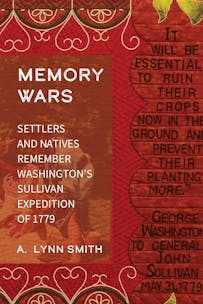
Purchase the book from University of Nebraska Press.
In Memory Wars: Settlers and Natives Remember Washington’s Sullivan Expedition of 1779, historian A. Lynn Smith explores historical memories of Revolutionary General John Sullivan’s military invasion of the homelands of the Haudenosaunee, also known as the Six Nations of the Iroquois Confederacy. General George Washington directed Sullivan to invade the Six Nations’ territory, located in present-day Pennsylvania and upstate New York, in retaliation for attacks on backcountry settlements and forts and to neutralize the threat of combined British-Haudenosaunee military action.
The Six Nations suffered greatly at the hands of Sullivan’s forces, which razed more than 40 villages, destroyed vital food stores and countless acres of crops and orchards, and displaced as many as 5,000 people who fled westward as refugees to the Niagara region. While some Haudenosaunee people were later able to return to their homes, where their descendants remain today, the Sullivan Campaign ultimately led to the forceful seizure of millions of acres of land by the new United States.
In the centuries since the end of the Revolutionary War, commemorations, historical markers, and celebrations have appeared along the route of “Sullivan's March,” even as Haudenosaunee descendants have continued to live nearby. Smith investigates not just the history of these commemorations and markers but also visits with the present-day representatives of the Six Nations to discover what it means to live side by side with these constant reminders of destruction and displacement.
Read an excerpt from Memory Wars to learn about Washington’s strategic goals for the 1779 Sullivan Expedition, which resulted in devastation and suffering that, for nearly 250 years, descendants of the combatants have lived among – and continue to grapple with – in the wooded mountains and narrow valleys of Pennsylvania and New York.
Excerpt
Washington's orders to Sullivan on May 31, 1779, were blunt: “The expedition you are appointed to command is to be directed against the hostile tribes of the six nations of Indians, with their associates and adherents. The immediate objects are the total destruction and devastation of their settlements and the capture of as many prisoners of every age and sex as possible. It will be essential to ruin their crops now in the ground and prevent their planting more.” After outlining troop composition and recommended tactical movements, Washington instructed him on how the Iroquois should be treated, writing, “the country may not be merely overrun but destroyed” (emphasis in the original). He added, “You will not by [any] means, listen to any overture of peace before the total ruin of their settlements is effected… Our future security will be in their inability to injure us… and in the terror with which the severity of the chastisement they receive will inspire [them].” Although Sullivan did not succeed in capturing many prisoners, he followed the rest of these instructions to the letter.
An initial assault, launched in April 1779 by Colonel Van Schaick, devastated the Onondaga Nation. Troops burned two villages and the longhouse that held the League's symbolic council fire. That summer, three coordinated troop movements took place: Sullivan, with three brigades, traveled from Easton and Wyoming north along the Susquehanna River; Gen. James Clinton of New York traveled south from the Mohawk Valley to meet Sullivan's forces at Tioga (now Athens, Pennsylvania); and Daniel Brodhead marched north from Fort Pitt to attack Indian settlements along the Allegheny River. The original plan was for these three branches to join forces to seize the major British installation of Fort Niagara; this Niagara component was abandoned in the end, and the destruction of Indian settlements became the troops' main occupation. Most of this destruction was carried out by Sullivan's three brigades in the summer of 1779 and directed to the heart of the Haudenosaunee homelands. According to Sullivan's accounting, they burned forty settlements and hundreds of acres of crops, orchards, and stored foodstuffs, including an estimated 160,000 bushels of corn. Gen. James Clinton brought similar destruction along the Mohawk River. Gen. Daniel Brodhead destroyed 165 houses in eleven Delaware and Seneca settlements and over five hundred acres of crops along the Allegheny River.
Sign Up
Get biweekly Read the Revolution featured excerpts right to your inbox.
The Sullivan Campaign did not end the war. The brigades that served under Sullivan left for other staging grounds, and the war raged on until British capitulation at the Battle of Yorktown (Virginia) in October 1781. Although a chorus of non-Native writers and speakers at historic and contemporary events commemorating Sullivan have claimed that the operation shifted the wartime balance of power, contemporary historians are mixed in their assessment of its strategic effects. Joseph Fischer called it a “well-executed failure,” as Sullivan never made it to the British base at Fort Niagara and never obtained the prisoners Washington had hoped could be used in future bargaining. Upon returning to Fort Pitt, Gen. Daniel Brodhead continued to face threats from Shawnee, Wyandot, and Haudenosaunee forces, indicating that his raids “had not completely accomplished their purpose of permanently silencing these Indians.” Barbara Graymont points out that the expedition was designed to break the power of the Iroquois and make the border regions safe, but it did not achieve either and, in fact, rallied the Iroquois to increase attacks against white settlements for the next several years. As Calloway notes, even while seeking refuge in Niagara, Iroquois vowed to take revenge. After delineating the results of their raids on frontier communities that ravaged New York and Pennsylvania, he includes, “Washington's war on Iroquoian homes and food generated more, not fewer, raids on American settlers.”
A. Lynn Smith, Memory Wars: Settlers and Natives Remember Washington’s Sullivan Expedition of 1779 (University of Nebraska Press, 2023), 12-14.
Learn More

Indigenous Continent
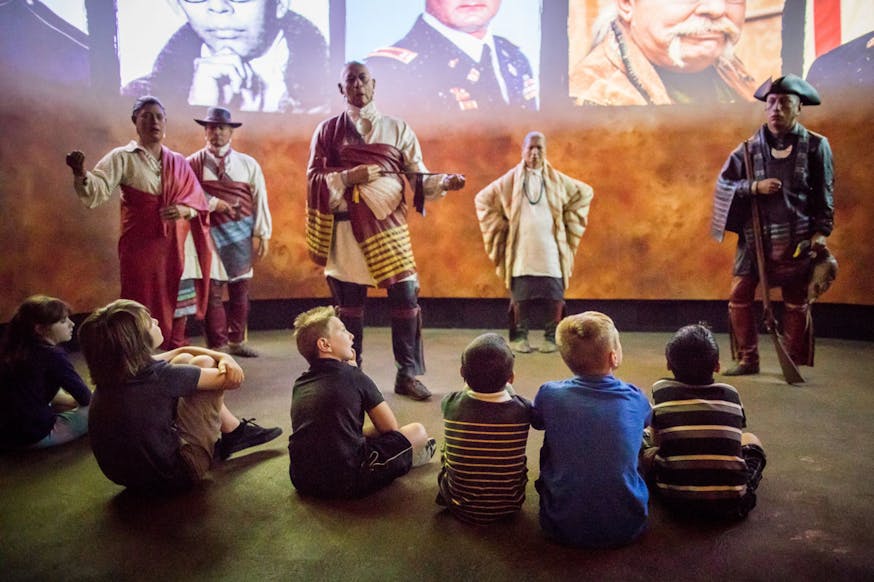
Meet the Figures: Oneida Nation Theater