

Read the Revolution
Bullet Strikes From the First Day of the American Revolution
April 9, 2025
Purchase the book from Gun and Sword Collector.
“And they all have a story to tell...” is what authors Joel Bohy and Douglas Scott note as their motivation for the years of forensic research on the surviving bullet holes and bullet-struck artifacts from the Battles of Lexington and Concord, which ignited the Revolutionary War. The culmination of this research is the newly released Bullet Strikes From the First Day of the American Revolution, which uses engaging imagery, first-person accounts from the battles, and the historical and archaeological expertise of the authors to illustrate the stories these witness objects can tell and the empathy they can inspire for the events of April 19, 1775.
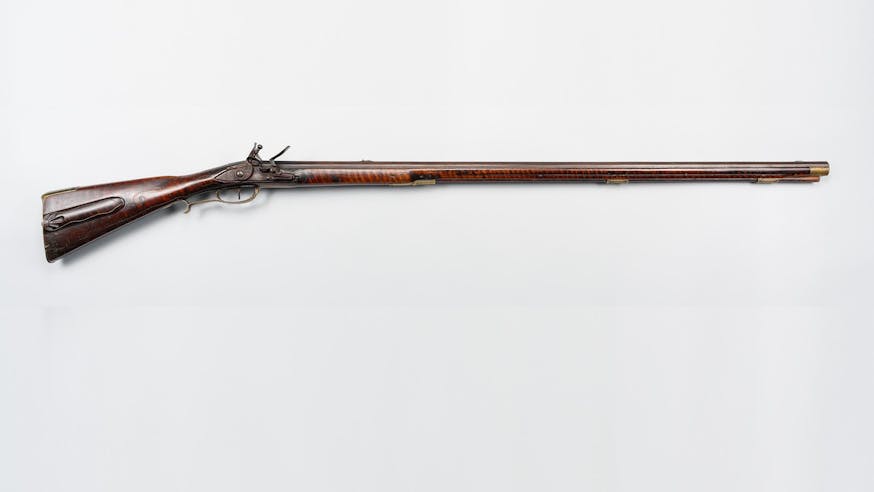
Bohy and Scott conducted rigorous scientific experiments, firing custom-built reproduction colonial and British firearms from the Revolutionary War, generating data that allowed them to reconstruct troop positions and movements all along “Battle Road.” This is what leads to the insightful interpretation of surviving bullet-struck objects and architectural elements from the battles outlined in Bullet Strikes From the First Day of the American Revolution, and helps readers understand why these events happened the way they did. Bohy and Scott give detailed explanations about surviving architecture and artifacts – including the Elisha Jones House, the Jason Russell House, the Buckman and Munroe Taverns, and James Hayward’s powder horn – and the people who slept within their walls or carried these objects in battles that raged just outside their doorsteps.
Related Content

Excerpt
We are about to embark on our tour down battle road, examining bullet holes and trying to learn as much as we can from them. But before we do that, we thought we should explain how we even know that a reported “bullet hole” is actually a genuine bullet hole from the fighting, and how science was used to bring us to the conclusions we are about to share with you.
... The study of shooting-related events is usually something reserved for law enforcement agencies – and many of our techniques came from that world. Determining whether a hole in wood was caused by a bullet is usually fairly easy. Bullet entry holes are generally quite smooth with not much splintering, while exit holes are much more messy, often ripping the wood’s fiber along its grain. The entry hole should be regular, setting it apart from knot holes, for instance. Measuring the diameter of the hole is also helpful, in order to make sure it is in the range of musket ball sizes used on that day. And we shouldn’t see any marks from drill bits or other tools.
A chemical test was used on most of these bullet holes in order to determine if traces of lead survive from a bullet passing through the wood. Forensic scientists call this a Presumptive Lead Test. It does no damage to the artifact and involves rubbing the inside of the hole with a moist cotton swab and then dipping the swab in a chemical solution that will turn pink if lead is present. While this test can be extremely useful, sometimes false positives can be caused by the presence of lead-based paint, and other times the holes have been rubbed so much by tourists or filled with plaster during repairs so as to make a positive result highly unlikely.
Next, we did what is called a live-fire validation study, going into the field and shooting flintlock firearms at similar materials to those being studied in order to confirm that what we were seeing in the original battle damage was consistent with similar punishment today. We also measured the velocity, penetrating power and range of these bullets to further inform our studies. The results were extremely encouraging.
Joel Bohy and Douglas Scott. Bullet Strikes From the First Day of the American Revolution. (Woonsocket, RI: Mowbray Publishing, 2025)
Learn More

Banners of Liberty: An Exhibition of Original Revolutionary War Flags
April 19 - August 10, 2025
"Banners of Liberty: An Exhibition of Original Revolutionary War Flags" Public Opening Event
April 19, 2025 from 10:15 - 11 a.m.