

2026 Call for Proposals
The International Journey of the Declaration of Independence
A convening at the Museum of the American Revolution
Philadelphia, PA
Sept. 25-26, 2026
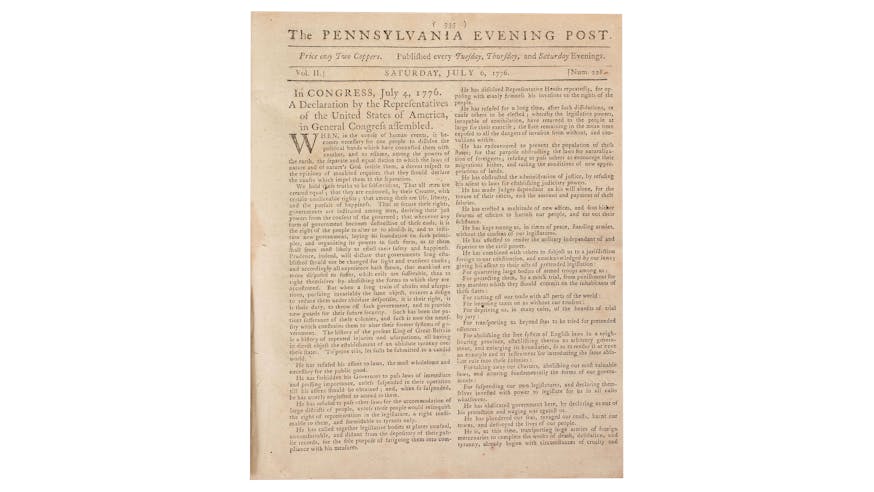
To commemorate the 250th anniversary of the U.S. Declaration of Independence, the Museum of the American Revolution created The Declaration’s Journey, a landmark exhibition that traces the evolution and global impact of the U.S. Declaration of Independence since 1776. The exhibition features artifacts related to the declarations of independence issued by France, Mexico, Chile, Poland, and more.
As the Museum’s curators and scholarly advisory team worked to develop The Declaration’s Journey, it was clear that the international aspect of the story represented an exciting area of new research and presented opportunities for future study. To further explore the international impact of the U.S. Declaration of Independence, the Museum will host a two-day convening on Friday, Sept. 25, and Saturday, Sept. 26.
The U.S. Declaration of Independence has become one of the most influential political documents in modern history. Since 1776, a declaration of independence has become an effective and widely accepted method for announcing sovereignty and political independence in the world. More than 120 nations have used one to chart a new course for their people. These declarations borrow language from the American declaration, while also challenging its internal contradictions, such as in the French Declaration of the Rights of Man and of the Citizen. In the immediate aftermath of World War I, a new burst of sovereignty statements appeared. Three of them—the Czechoslovakian (1918), Korean (1919), and the Declaration of Common Aims of Twelve European Nations (1918)—not only used language from the U.S. Declaration, but also enacted their adoption in Independence Hall in Philadelphia.
International interpretations of the Declaration of Independence have also spurred Americans to clarify their own understanding of their founding document. The French Declaration of the Rights of Man and of the Citizen of 1789 was first drafted by the Marquis de Lafayette with advice from Thomas Jefferson, the principal author of the Declaration of Independence. Lafayette’s draft borrowed the language of “unalienable” rights and “happiness” but clarified the language about equality by phrasing it as a birthright of all men, rather than a product of distant creation. The Polish Revolution of 1794, led by another American Revolutionary War veteran, Thaddeus Kosciuszko, equally used the Declaration’s language of “happiness” and the right to revolution, but pushed the emancipatory agenda of equality by freeing the serfs of Poland. The Haitian Declaration of Independence of 1804 presented a revolution for the rights of formerly enslaved people and threatened the slave powers of the United States. Revolutionaries in Mexico who were committed to emancipation and abolition borrowed language from both the egalitarian statements in the United States Declaration of Independence and the French Declaration of the Rights of Man and of the Citizen. When Mexico adopted a new, more centralized constitution in 1835, Texans declared independence in part to defend their right to own enslaved people in a major dress rehearsal of the American Civil War.
The examples above are just a handful of ways the U.S. Declaration has influenced other independence efforts. The convening will bring together scholars from around the world to explore the influence and legacy of the U.S. Declaration of Independence in an international context. Possible session themes might include, but are not limited to:
- How revolutionary leaders encountered and adapted the U.S. Declaration of Independence to their own circumstances
- How historiography about the international impact of the U.S. Declaration has evolved since the Bicentennial
- How the U.S. Declaration’s language has been transformed and adapted by other revolutionary declarations
- How the rights and grievances espoused by the U.S. Declaration provided an intellectual framework for subsequent revolutions and revolutionary movements
- How the U.S. Declaration helped shape modern ideas about the nation state
- The material culture and communication technology of revolution
- Further areas of research around the U.S. Declaration to explore
Scholars at all stages of their careers are welcome, including independent scholars and advanced graduate students. The convening aims to foster a collegial and collaborative environment for discussion and further research in this area. The working language of the conference is English.
The details:
Formats: Scholars are invited to submit proposals for individual papers, panels, or roundtables. Sessions are currently scheduled for 90 minutes, with individual papers no more than 20 minutes in length. Presenters are encouraged to use audio-visual elements in their presentations.
Honorarium and Travel Costs: Presenters must be physically present for the conference. They will receive an honorarium of $750 along with compensation for their travel costs. We hope that this will lower the barriers for overseas scholars and those with limited or nonexistent institutional travel support. Travel costs include transportation, hotel, and per diem. Presenters are expected to attend both days of the conference.
Conference Location: Museum of the American Revolution, Philadelphia, PA
Access: The convening will be streamed online to make the proceedings available to an international audience. Presenters will be asked to sign a waiver giving permission to do so.
Proposal deadline: Jan. 15, 2026
How to apply: Send an email to [email protected] with the following:
- For individual papers: Include a Word document with name, affiliation, paper title, and a one-paragraph abstract of paper to be presented. Also provide a one-page CV.
- For panels or roundtables: Include a Word document with the names, affiliations, paper titles, and one-paragraph abstracts of papers to be presented. Provide one-page CVs for all participants.
The conference committee will notify applicants of their acceptance of their paper/panel/roundtable in early 2026.
Questions? Please send an email to [email protected].
Learn More

The Declaration’s Journey
October 18, 2025 - January 3, 2027
Revolution Around the World