

The Declaration's Journey
The Declaration Around the World: Chile
December 10, 2025
By Dr. Emily Sneff
This essay is part of a content series exploring the nations, stories, and themes included in the Museum’s special exhibition The Declaration’s Journey, presented by Griffin Catalyst, on view through Jan. 3, 2027.
The Declaration’s Journey highlights all sorts of declarations—some of which came at the beginning of a movement, and some of which came after years of struggle and, in many cases, bloodshed. In Chile, the fight for independence stretched on for years before a formal declaration of independence from Spanish rule.
Napoleon Bonaparte’s invasion of Spain in 1808 put Chile and other Spanish territories in South America in a predicament, leaving colonial officials wondering where legitimate political power resided. In 1810, after debates about the power of kings, governors, and groups that took power by force, or juntas, a provisional government was set up that was loyal to Ferdinand VII as the Spanish monarch, even though Bonaparte had given the crown to his brother. Then in 1811, José Miguel Carrera seized control from the provisional government, and the voices advocating for independence from Spain grew louder. One of the largest objects in The Declaration’s Journey is a printing press, sent from the United States to Chile after Carrera came to power. In November 1811, a ship arrived in the major Chilean port of Valparaíso with the printing press, as well as a team of men to run it, and boxes of firearms. This shipment shows that the fight for independence required both words and weapons, as well as support from other nations, including the United States. Colonial Chile and the United States had had a relationship since they began trading goods in the 18th century, and American merchants, looking for lessened commercial restrictions under a new Chilean government, were eager to support the revolution. Priest, author, and politician Camilo Henríquez used the printing press to publish Chile’s first newspaper, the Aurora de Chile, beginning in 1812.
Efforts to establish a permanent, independent government in Chile persisted for years through military conquests, political installations, and exiles of revolutionary leaders. Bernardo O’Higgins—who was of both Spanish and Irish ancestry—became the Supreme Director of Chile in February 1817 after the Battle of Chacabuco, a decisive victory for the pro-independence forces against the Spanish royalists. Then in November 1817, a referendum was held to determine whether the Chilean people supported declaring independence from Spain.
The Chilean declaration of independence was dated Jan. 1, 1818 and formally issued on the first anniversary of the Battle of Chacabuco on Feb. 12, 1818. The document referred back to 1810 and Chile’s first efforts to fulfill its destiny of being independent. Although the declaration does not explicitly list grievances against the Spanish monarchy, it does refer to “los abusos,” or the abuses or the Spanish government, and the “último desengaño,” or final disillusionment, which brought Chile to this moment of claiming independence. The declaration was signed by O’Higgins as Supreme Director of Chile, along with his ministers Miguel Zañartu, Hipólito de Villegas, and José Ignacio Zenteno.
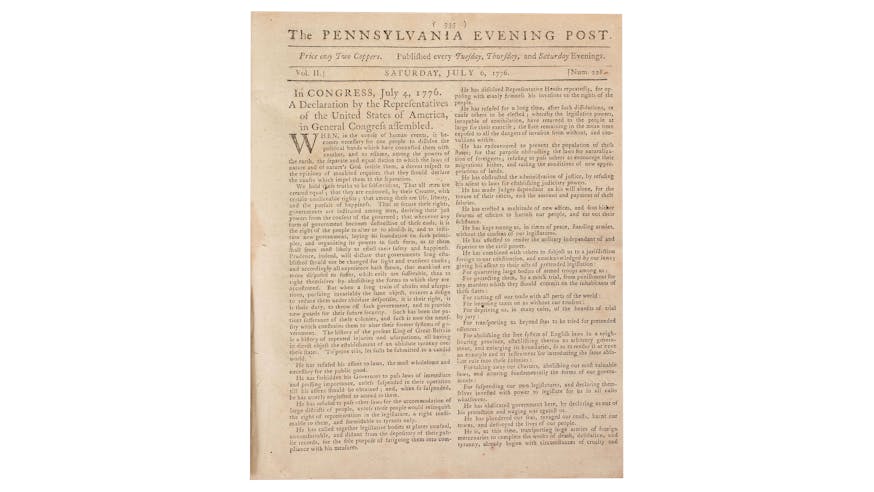
The influence of the United States Declaration of Independence on Chile’s declaration of independence is clear, despite the Chilean declaration being a much shorter text. It states that Chile is free, independent, and sovereign, and forever separated from the Spanish monarchy. The declaration concludes with a pledge from the signers that is similar to the final line of the United States Declaration: “el honor, la vida, las fortunas,” or their honor, life, and fortunes. Just as the Continental Congress had ordered the United States Declaration to be widely published in the summer of 1776, the Chilean declaration of independence included a provision to circulate the news to all the towns, military forces, and assemblies so that the people would immediately know about “la emancipation de Chile,” or the emancipation of Chile.
Dr. Emily Sneff is an early American historian, guest curator of The Declaration’s Journey, and leading expert on the United States Declaration of Independence, as well as the author of When The Declaration of Independence Was News, coming in April 2026.
"The Declaration's Journey" is presented by

Learn More

The Declaration’s Journey
October 18, 2025 - January 3, 2027
Revolution Around the World