

Read the Revolution
When the Declaration of Independence Was News
July 1, 2026
Many Americans can quote the Declaration of Independence by heart and readily picture the iconic handwriting on the engrossed parchment copy. But 250 years ago, when people first heard and read that “all men are created equal,” the Declaration was news. Historian Emily Sneff, guest curator of the Museum’s special exhibition, The Declaration’s Journey, presented by Griffin Catalyst, illuminates this story in her new book, When the Declaration of Independence Was News. Sneff traces how news spread of early moves towards independence and how the Declaration was received in New York and Boston, among Native Americans, and abroad. “As news,” she reminds us, “the Declaration of Independence was malleable, easily combined with other pieces of information and misinformation, or overshadowed by other stories.” Sneff’s new book progresses like a good detective story, following leads to uncover how the Declaration began its journey around the world.
Related Content

Excerpt
In printing offices all over Philadelphia, compositors picked out a capital I from their typecase. They flipped the thin piece of metal on its head, slid it into place in their composing stick, and held it with the tip of their thumb as they reached for the next letter. For most, that next letter was an N; for the German printers in town, it was an M. The compositors worked until the metal type formed a small block of words that they could carefully slide out of their sticks and lock into the form before moving on to the text that would follow the title: In Congress, July 4, 1776. A Declaration by the Representatives of the United States of America, in General Congress assembled. Or, in German: Im Congreß, den 4ten July, 1776. Eine Erklärung durch die Repräsentanten der Vereinigten Staaten von America, im General-Congreß versammlet.
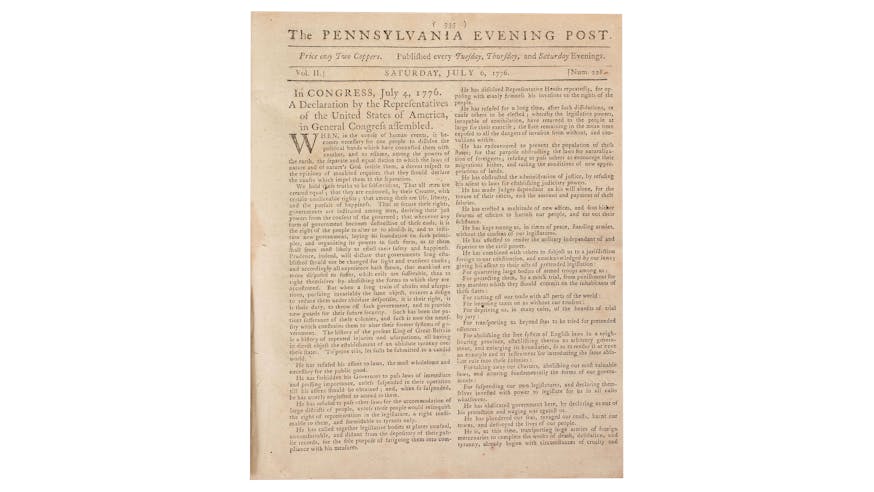
Many people in the United States—beginning in Philadelphia—learned about the Declaration of Independence through public readings and printed broadsides and newspapers. After John Dunlap produced the first broadsides of the text, he and his fellow printers published the Declaration in their respective newspapers. One Philadelphia bookseller even added the Declaration as an appendix to an anonymous pamphlet already on the printing press. German printers in Philadelphia produced the first translations of the Declaration within days of July 4. The Pennsylvania Committee of Safety scheduled the first public readings of the Declaration for an election day, when the men who were eligible to vote would decide who would craft a new constitution for the commonwealth. By the time the constitutional convention began on July 15 in Philadelphia, the Declaration was no longer news in the city. It moved on to other places, the columns of other newspapers, and readings in other public squares.
From July through mid-August 1776, the Declaration of Independence was printed and proclaimed across the United States. Many public readings followed a formula that was familiar from years of civic celebrations for King George III and his predecessors, but with a few decidedly different elements. In town after town, civilians and soldiers assembled outside of a courthouse or another central location. A local official, oftentimes the sheriff, read the Declaration aloud, and when he reached the end of the text the people responded with cheers and the soldiers fired off a salute. The celebration often stretched into the evening, lit by bonfires fueled by the wooden coats of arms and signs and symbols of the British crown that were taken down from the buildings around town. People also read the Declaration in private, in their local newspaper or broadsides that some printers made available to purchase.
The Declaration promoted a new national identity and sense of purpose. The process of publishing the news of independence drew people together but also ostracized people who did not want to openly support independence. And, in their haste to spread the news, printers made mistakes—some innocuous but some surprising for a text as important in hindsight as the founding document of the United States.
Sign Up
Get biweekly Read the Revolution featured excerpts right to your inbox.
The first printer of the Declaration of Independence was John Dunlap. When he was young, Dunlap immigrated from County Tyrone in Northern Ireland to Philadelphia. He learned the printing trade from his uncle, and by 1776 he had been running his own business for a decade. Dunlap had printed many resolutions for the Continental Congress, but the resolution that the Congress asked him to print on July 4 was different.
In his office at the southeast corner of Second and Market Streets, Dunlap set to work on a large broadside of the Declaration. He relied on a clean, handwritten copy of the Declaration as approved by the Congress, and he may have been supervised by one or more members of he drafting committee. Dunlap did not work alone, and he did not work perfectly. A peculiar fragment of one of his broadsides has strange marks ( ‘ ‘ ) around certain phrases in the first two paragraphs. Perhaps these marks had been inadvertently left on the manuscript that Dunlap was copying, and whoever set the type had initially thought that they were part of the text but then removed them from the typesetting.
John Dunlap designed a broadside of the Declaration of Independence that communicated its importance. Compared to other resolutions of the Continental Congress that Dunlap had printed, the Declaration was large and impressive. Dunlap put “In CONGRESS, July 4, 1776” before the title that had stuck with the text since Thomas Jefferson’s rough draft: “A Declaration by the Representatives of the UNITED STATES OF AMERICA, In General Congress assembled.” For the first word of the Declaration, “WHEN,” Dunlap used a large initial W, the height of six lines of text. On Dunlap’s press, the grievances were arranged in separate, indented lines, as they had been in Jefferson’s drafts. Small capitals were used to emphasize the first word of each grievance. The final paragraph of the Dunlap broadside contains many more capitalized words than the preceding paragraphs, including, as in the title, “UNITED STATES OF AMERICA.” The single, wide column of text would have been easy to read, whether from a platform in front of a clamoring crowd or in a shadowy printing office while trying to find the right letters in the typecase to copy from Dunlap’s printing for another broadside or newspaper.
After the type was set correctly, John Dunlap and his workers would have fallen into the repetitive motions of printing. They would have lightly inked the surface of the type, set a sheet of slightly damp Dutch-made paper in the frame, laid the paper against the type form, added pressure to transfer the ink to the page, and hung the freshly printed sheet to dry. There is no record of how many copies of the broadside Dunlap’s printing office churned out on the night of July 4 and the morning of July 5, but they surely numbered in the hundreds. As the hours ticked by, the form holding all the pieces of type in place evidently loosened slightly and a word fell out, since one extant Dunlap broadside is missing the word “our” in the phrase “the Ties of our common Kindred” in the penultimate paragraph. Either the printer immediately noticed and corrected the error, or he missed it, and this broadside is the lone survivor of a bad batch. During the printing process, the very last line of type—the imprint reading “Philadelphia: Printed by John Dunlap”—shifted slightly to the left. At some point, Dunlap changed the name of the city within the imprint: one surviving broadside reads “Baltimore: Printed by John Dunlap.” Perhaps Dunlap, hoped to profit from the Continental Congress’s order by selling some of these broadsides at his Baltimore printing office.
The most important thing about the Dunlap broadsides is not where they were produced but where they went. Out of the hundreds of Dunlap broadsides that must have been printed on July 4 and 5, only twenty-five with the Philadelphia imprint are known to survive. Each has had a unique history since 1776. None of these copies look as pristine as they did coming off Dunlap’s press, with the dark ink shining on bright imported paper. Many were folded before the ink was completely dry, evidence of the haste with which they were disseminated. Some were kept folded up for too long, and the fold lines have made the paper brittle and left lacunae or gaps that make this familiar text hard to read. Charles Thomson, secretary of the Continental Congress, folded up one Dunlap broadside and used red wafer seals to stick it to a page of his handwritten journals. In order to preserve this copy, conservators at the National Archives had to remove it from the journal, wash it with purified water, remove the old adhesive, fill in holes with paper pulp, and use Japanese paper to support the back of the sheet. This copy became the Congress’s official record of what the Declaration of Independence would look like as it was sent out across the country. It was the one Dunlap broadside that stayed in place, in the secretary’s records, as the rest started to circulate. And it still wore out over time.
Sneff, Emily, When the Declaration of Independence Was News (Oxford University Press, 2026). pp. 53-56.
Learn More

The Declaration’s Journey
October 18, 2025 - January 3, 2027
Celebrate the Semiquincentennial: America's 250th Anniversary