

Read the Revolution
Thomas Jefferson Survives
June 3, 2026
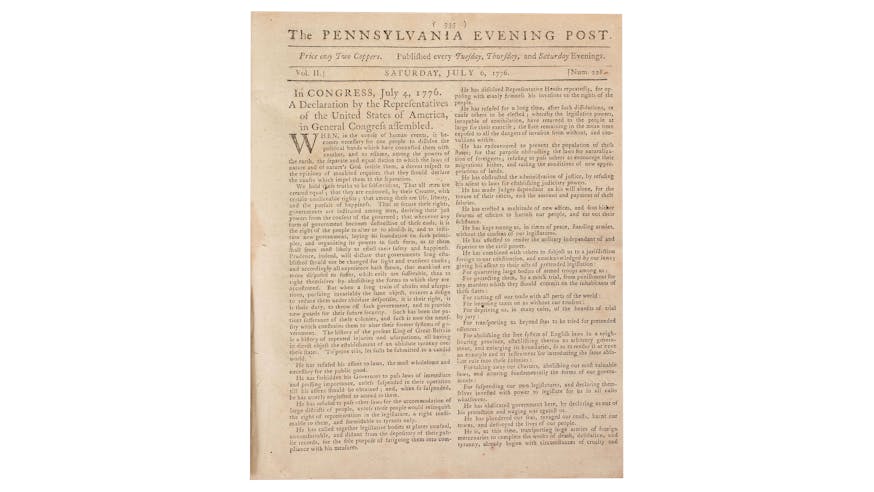
What did American history mean for Thomas Jefferson in his time, and how would he have viewed American democracy, generations later? 250 years ago this summer, while in Philadelphia, Jefferson was a Virginia delegate to the Second Continental Congress and knew that his assignment to draft the U.S. Declaration of Independence would make history.
In Thomas Jefferson Survives: American Independence in His Time and Ours, leading historians and professors Peter S. Onuf and Francis D. Cogliano join forces to reflect on how Jefferson’s reputation and legacy were shaped by his own experience, education, and sense of history. Before his death in 1826, Jefferson wrote instructions to be remembered as “... Author of the Declaration of Independence[,] of the Statute for religious freedom & Father of the University of Virginia” to anyone who would visit the obelisk at his Monticello gravesite. Living in Virginia, Philadelphia, and Paris, Jefferson read news from international revolutions and discussed ideas of independence and democracy in both his private and professional life. With timely insights into how Jefferson experienced and shaped American history, Onuf and Cogliano investigate whether the“history of the United States is therefore the story of whether Americans have succeeded or failed to live up to the ideals that Jefferson articulated in the Declaration” in three essays that ask, “does Jefferson matter?”
Read an excerpt from Onuf and Cogliano’s first essay, “Generations,” about how Jefferson perceived the past.
Related Content

Excerpt
In this essay we ask what history meant to Jefferson. We explore a number of themes, beginning with how Jefferson thought about the past. Like many of his fellow provincial patriots, Jefferson was attracted to the Whig interpretation of British history, chronicling the ongoing struggle between liberty and tyranny. Jefferson drew on this history when he sought to justify resistance to British tax policy in the colonies, which in turn led him to question Parliament's pretensions to absolute authority—or sovereignty-—throughout the empire. When American patriots appealed to Whig history, their goal was not to overthrow British rule in North America but to reform and improve it.
The War of Independence began in Massachusetts on April 19, 1775, when Jefferson was a thirty-two-year-old planter and lawyer living in the Virginia Piedmont. A steadfast critic of British rule in America since he was first elected to serve in Virginia's assembly in 1769, Jefferson had gained recognition as one of the more fervent and articulate defenders of colonial rights with the publication of his pamphlet A Summary View of the Rights of British America in 1774. Elected to represent Virginia in the Continental Congress on March 27, 1775, shortly before the outbreak of war in New England, Jefferson helped draft several addresses and declarations during the following months that outlined the colonial critique of Parliament's right to rule the colonies, including Congress's "Declaration of the Causes of Taking Up Arms," as well as resolutions in response to a reconciliation proposal advanced by the British prime minister, Frederick, Lord North.
Jefferson developed a distinctively provincial version of Whig history in these early writings to justify his defense of Virginia's rights in the escalating imperial crisis, our second major theme. The young author and politician developed his historical thinking most fully in his Summary View and in an incomplete, unpublished essay drafted in January 1776. Jefferson sought to show that the British constitution had extended to the colonies from their first settlement. By 1776 that position was no longer tenable. George III rejected the idea that there could be any constitutional limitations on his authority or that of the imperial Parliament in his dominions overseas. In Common Sense (1776), expatriate radical Thomas Paine denied that Britain had a proper constitution, calling the king's authority into question. The British king commanded great power—as embattled Americans well understood-but he did not exercise legitimate authority.
Failing to resolve the crisis between Britain and the American colonies by appealing to their shared history, Jefferson then deployed a compressed historical account of recent events to justify the final break with Britain in the Declaration of Independence. In so doing he began to craft a new history for an independent people. This is our third theme. No longer focusing on Virginia's provincial claims within the British Empire, Jefferson and his fellow revolutionaries began to construct a transprovincial, national narrative. Although he never completely jettisoned Whiggish notions of history and continued to emphasize the contest between liberty and tyranny, for Jefferson, British history now functioned as a negative reference or counterpoint for independent Americans. Freed from Britain's despotic rule, the new nation charted its own course forward, a beacon of progress for a benighted world. The new national narrative began with the history of the American Revolution, the history Jefferson and his fellow patriots were making when they declared and waged war for independence, a history that anticipated the future course of events for the people who emerged from that long conflict.
[...]
Sign Up
Get biweekly Read the Revolution featured excerpts right to your inbox.
To better understand Jefferson, we need to understand his approach to the past. We must ask ourselves how his historical consciousness maps onto our history — the history Jefferson and his contemporaries made. It is not enough to put Jefferson's ideas in context, for context itself can be a trap. We are too prone to assume that we, with our ostensibly Olympian perspective, can see the whole picture, failing to realize that we are doing exactly what Jefferson did with respect to British history: choosing an interpretation that suited his contemporary needs. Ultimately, our appreciation of Jefferson's understanding of the past is limited by what we know or think we know about that past. We may have the advantage of hindsight, knowing what Jefferson did and failed to do and therefore concluding that his intentions are "self-evident." But we need to put ourselves in his place and try to see his world through his eyes to understand how he understood the past.
Jefferson was a lifelong student of history. He owned more than five hundred books on ancient and modern Europe, Britain, and America when he offered his library for sale to the United States to replace the congressional library burned by the British in 1814. In 1813, Jefferson, living in retirement at Monticello, expressed his disgust for politics. "I turn from the contemplation [of current events] with loathing, and take refuge in the histories of other times." For Jefferson, history was not simply a diversion; it offered a guide to the present and moral and political lessons for the future. The history he most valued enabled readers to take the long view, offering them a collective, cross-generational judgment on characters and events. Such a perspective came naturally to a lawyer like Jefferson, steeped in the common law. History was also vitally important, he believed, to rising generations in the new American republic.
Cogliano, Francis D. and Onuf, Peter S., Thomas Jefferson Survives: American Independence in His Time and Ours (W.W. Norton, 2026), 24-28.
Learn More
Read the Revolution Speaker Series
Go to Page
The Declaration’s Journey
October 18, 2025 - January 3, 2027