

Read the Revolution
The Great Contradiction
December 3, 2025
The themes explored in the Museum’s latest special exhibition The Declaration’s Journey, presented by Griffin Catalyst, echo Joseph Ellis’s central argument in The Great Contradiction: The Tragic Side of America’s Founding. The argument is that the Founders simultaneously proclaimed a universal ideal — “that all men are created equal” — and built a political system that excluded large segments of the population from that ideal. Ellis outlines that while the Founders understood the moral power of equality as a guiding principle, they left it deliberately unresolved. This tension, he contends, was a structural ambiguity embedded in the nation’s founding, one that enabled unity against British oppression while postponing the divisive issues of slavery and the rights of women, Indigenous peoples, and others.
The Museum’s exhibition traces how the meaning of the Declaration has evolved far beyond what its authors envisioned. It demonstrates how the document became a living text — one that later generations in the United States and around the world repeatedly reinterpreted and redeployed in struggles for justice. By highlighting abolitionists, suffragists, civil rights leaders, and contemporary activists who have invoked the Declaration to expose hypocrisy or demand expanded rights, the exhibition reveals the enduring power of its language. These groups recognized that although the promise of equality was limited at the nation’s founding, it offered a vocabulary and a guiding principle through which to advocate for rights and liberties.
The following excerpt examines how the Declaration of Independence was written, revised, debated, and understood — and how the words “that all men are created equal” became the most lasting and consequential part of the document.
Related Content

Excerpt
History was happening at an accelerating pace throughout the summer of 1776. On June 7, Richard Henry Lee of Virginia moved the resolution "that these United Colonies are, and of right ought to be, independent States.' (Note the state-based assumption underlying the rationale for independence.) Congress decided to delay a vote on Lee's resolution until July 1 in deference to delegations requiring guidance from their respective state legislatures. In the meantime, a five-member committee was appointed to draft a document announcing American independence to the world if and when Lee's resolution won approval. No one knew it at the time— more pressing events were occurring in the still-undecided Pennsylvania and New York legislatures, not to mention the landing on Staten Island of the first wave of the British invasion force under General William Howe—but the congress had just appointed the most consequential committee in American history.
[...]
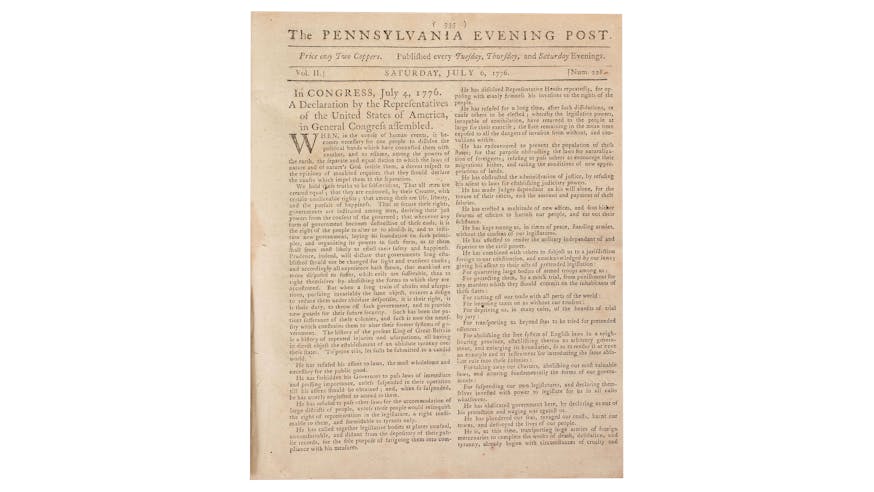
After voting unanimously on July 2 in favor of Lee's resolution (New York abstained), the delegates put themselves into committee-of-the-whole format to debate Jefferson's draft of the Declaration. No record of the debate exists, because none was kept. They made more than eighty editorial changes, revising or deleting over 20 percent of the text. Almost all the changes occurred in the long list of grievances against George IlI, in which Jefferson prosecuted the British king for violating the colonists' rights as Englishmen, thereby severing the only remaining connection with the British government. Nothing in this prolonged indictment bore directly on the slavery issue, except for one lengthy paragraph, which his fellow delegates deleted altogether, presumably because it raised the unmentionable subject, perhaps because it was the most incoherent piece of prose that Jefferson ever wrote.
He has waged cruel war against human nature itself, violating its most sacred rights of life and liberty in the persons of a distant people who never offended him, captivating and carrying them into slavery in another hemisphere, or to incur miserable death in their transportation hither. This practical warfare, the opprobrious of INVIDEL powers, is the warfare of the CHRISTIAN King of Great Britain. Determined to keep open a market where MEN should be bought and sold, he has prostituted his negative for suppressing every legislative attempt to restrain this execrable commerce. And that this assemblage of horrors might want no fact of distinguished die, he is now exciting those very people to rise in arms against us and to purchase that liberty of which he has deprived them by rendering the people on whom he has obtruded them, thus paying off former crimes against the liberties of one people, with crimes which he urges them to commit against the LIVEs of another.
One way of reading the deleted paragraph is to view it as a message aimed primarily at a Virginia audience. The Virginia legislature was on record for ending the slave trade, since their plantations were overstocked, and they stood to benefit if the Carolinas and Georgia became customers in a domestic version of the slave trade. So Jefferson's condemnation of the Atlantic Slave Trade as a moral travesty was politically popular in the Old Dominion. The claim that George Ill was "exciting those very people to rise in arms among us" referred to a proclamation by the royal governor of Virgina, Lord Dunmore, that offered freedom to all Virginia slaves who rallied to the British cause. By denouncing Dunmore's offer of emancipation, Jefferson seemed to contradict his own critique of George Ill for allegedly imposing slavery on the American colonies. None of this made rational sense.
It did, however, make a kind of revolutionary sense to fold slavery into the list of grievances against George III, using the political crisis to create a patriotic storyline in which an evil king imposes a diabolical institution on innocent and unwilling colonists. This, of course, was a preposterous piece of patriotic propaganda, but in the superheated moment, when blaming George III for a long train of abuses had become rhetorically possible and politically mandatory, adding slavery to the bill of indictments was an inspirational act. After all, since the occasion called for an indictment of the British king, why not add slavery to the list of criminal offenses, thereby laying the political foundation for emancipation in the document declaring America's own emancipation from British tyranny?
That question became a purely rhetorical concern as soon as the delegates in the congress deleted the entire paragraph. There were surely stylistic reasons for the decision: the convoluted syntax, strange word choice, operatic tone, all of which were out of place in a diplomatic document. Even Jefferson, the proven master of the written word, apparently lost his customary control when trying to mention the unmentionable. But, at least in retrospect, his instincts were excellent: the impulse to declare to the world that slavery was inherently incompatible with America’s founding principles, and to blame the whole problem on a discredited British king.
Because most delegates were fixated on the lengthy indictment of George III and the arguments that he had violated their rights as Englishmen, they ignored altogether the second paragraph of the Declaration, presumably regarding it a rhetorical overture. For understandable reasons, they focused their attention on the pressing matter of the moment, which was whether to take the final step, the long-differed leap toward independence, in the process risking, as Jefferson rather eloquently put it, “our lives, our fortunes, and our sacred honor." They were looking straight ahead, not gazing upward at the political stratosphere. As a result, they ignored altogether what were destined to become the fifty-six most important words in American history:
We hold these truths to be self-evident, that all men are created equal, that they are endowed by their creator with certain unalienable rights, that among these are Life, Liberty, and the pursuit of Happiness. That to secure these rights, Governments are instituted among Men, deriving their just powers from the consent of the governed.
Sign Up
Get biweekly Read the Revolution featured excerpts right to your inbox.
Jefferson's mind did its best work at high altitudes, where his verbal fluidity also found its comfort zone. These talents allowed him to smuggle, in plain sight, the core principles of the natural-rights philosophy into the seminal document of the American founding. No less a figure than Abraham Lincoln, who could rival Jefferson in his way with words, put it most poignantly: "All honor to Jefferson, to the man who, in the concrete pressure of a struggle for national independence by a single people, had the coolness, forecast, and capacity to introduce into a merely revolutionary document, an abstract truth, applicable to all men and all times, and so to embalm it there, that today, and in all coming days, it shall be a rebuke and a stumbling block to the very harbingers of re-appearing tyranny and oppression." One can only assume that Lincoln was smiling when he wrote "a merely revolutionary document."
Lincoln also called attention to another covert feature of Jefferson's magic words—-namely, that they floated in a timeless zone far above the pressing demands of the moment. "The assertion that all men are created equal," Lincoln wrote, "was of no practical use in effecting our separation from Great Britain, and it was placed in the Declaration, not for that, but for future use." More specifically, although Jefferson's words were self-evidently incompatible with slavery, that obvious fact remained unspoken. A basic human right was being declared, but enforcement of that right was being deferred. Eternal principles could not be scheduled.
Jefferson also inserted covertly antislavery language into the futuristic paragraph when he revised the trinity of rights most famously proposed by John Locke in his Second Treatise on Government (1690). Instead of "life, liberty, and property," Jefferson wrote "Life, Liberty, and the pursuit of Happiness." He borrowed the new phrase from George Mason, who had used it in his draft of the Virginia Constitution as a supplement to Locke's "property." By dropping "property" altogether, Jefferson deftly deprived slave-owners of the claim that owning slaves was a natural right protected by law. On this score, there can be little doubt that Jefferson knew what he was doing."
For the rest of his life, Jefferson complained about the revisions made in his draft of the Declaration. ("Mangled" was his customary complaint.) But the manglers had left the natural-rights paragraph untouched. Over the years, as the meaning of Jefferson's words expanded, advocates of the abolition of slavery, women's rights, then racial equality and gay rights came to regard them as the semi-sacred core of the American promise, the only words in the Declaration of Independence that really mattered.
Ellis, Joseph J.: The Great Contradiction: The Tragic Side of the American Founding (New York: Alfred A. Knopf, 2025). 40-45.
Learn More

The Declaration’s Journey
October 18, 2025 - January 3, 2027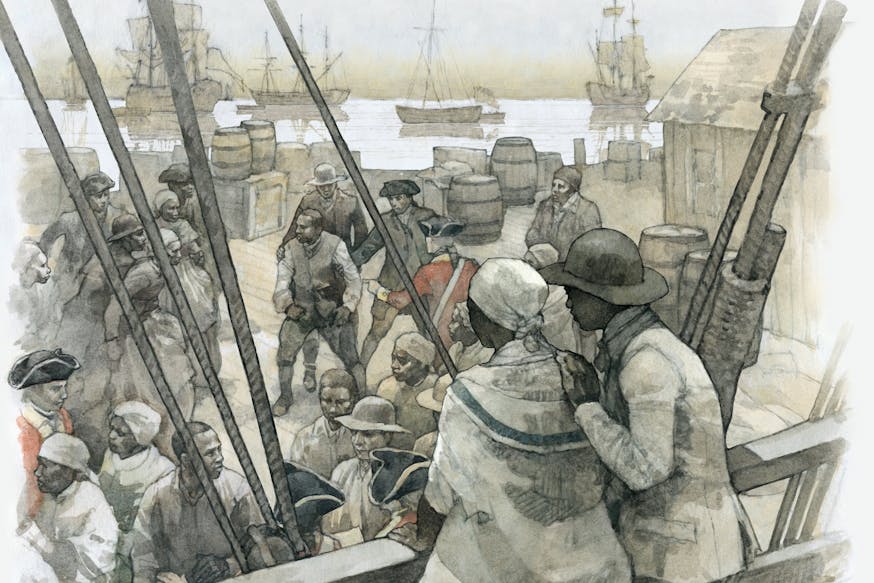
Finding Freedom