

Read the Revolution
The Declaration's Journey
October 22, 2025
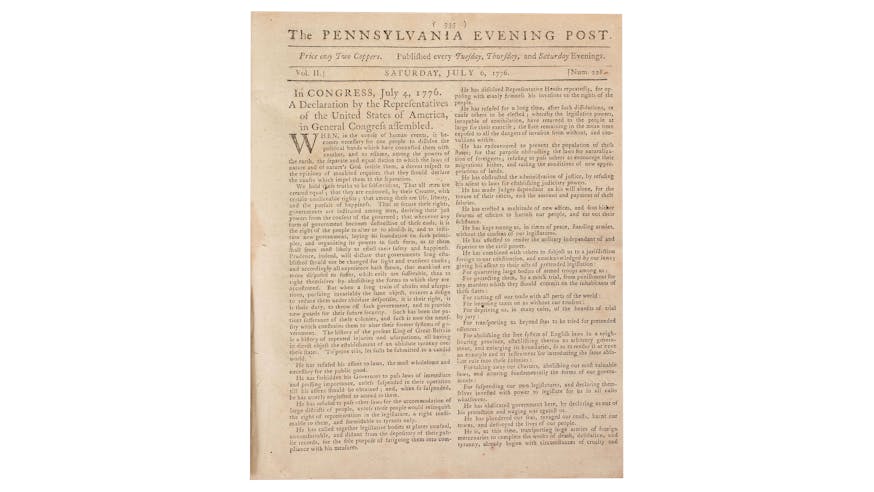
On Oct. 18, 2025, the Museum opened its most ambitious special exhibition, The Declaration’s Journey, presented by Griffin Catalyst, which explores the 250-year global impact of the Declaration of Independence. As a companion to the exhibition, we published a richly illustrated catalog, which like the exhibition, is laid out in four sections arranged chronologically: “The Declaration’s First Travels,” “The Declaration in the Age of Revolutions,” “A Divided Declaration,” and “The Declaration and the World.” Over 100 documents, artifacts, and works of art are included in the exhibition and illustrated in the catalog to help to drive the narrative. A foreword written by the Museum’s President and CEO, R. Scott Stephenson, sets the stage for the stories shared in the book.
The Declaration’s Journey features independence movements from across the globe. It shares details and presents artifacts connected to nations in Asia, South America, North America, Africa, and Europe. The catalog highlights the independence of Haiti, Chile, Mexico, Korea, Czechoslovakia, Ireland, and India. It also discusses how, since 1776, generations of revolutionary Americans have worked to strengthen the nation’s commitment to its founding ideals. Images and artifacts share the stories of Frederick Douglass, William Lloyd Garrison, Elizabeth Cady Stanton, Eleanor Roosevelt, Martin Luther King, Jr., Harvey Milk, and others.
Read an excerpt from the first chapter of The Declaration’s Journey that explores this question: was the Declaration of Independence written for the United States or for the world?
Related Content

Excerpt
Finding Recognition in a “Candid World”
When the Continental Congress declared independence, the delegates were also hard at work
drafting the Articles of Confederation, a document meant to unite the states under one government, and a model treaty that could be used to secure alliances with European powers, especially France. The delegates knew that, if they were going to win the war against Great Britain, they would need other nations to recognize the independence of the United States.
Only weeks after July 4, 1776, Native American nations were the first foreign powers to formally acknowledge the independence of the United States. It took more time and considerable diplomatic effort—conducted across the Atlantic Ocean—to secure an alliance with France, which set the stage for other European nations to treat the United States as independent and sovereign. Ultimately, Great Britain did not recognize the independence of the United States until 1783, seven years after the Declaration.
The Declaration in Parliament
In October 1776, King George III delivered his first speech before the British Parliament since the Declaration of Independence. He had hoped that his “unhappy people” would have “recovered from their delusion” and reconciled with their king. Despite his disappointment, the king saw one advantage to the rebels’ decision. He believed that the Declaration would foster “unanimity at home,” in Great Britain and the halls of Parliament.
By 1778, British unanimity was faltering. Parliament prepared to debate whether to recognize independence or keep fighting. They pulled together copies of reports from the king’s commissioners in North America, including a copy of the Declaration of Independence. Despite poor health, William Pitt, the Earl of Chatham, delivered a rousing address in the House of Lords in defense of the war effort. He then collapsed and later died. But Parliament agreed with his position and decided to continue the war against American independence.
Native Americans Recognize Independence
The first acknowledgement of the independent United States by a foreign power happened in Massachusetts in July 1776. The text of the Declaration of Independence arrived in the middle of treaty negotiations between Massachusetts officials and a delegation of Wolastoqiyik and Mi’kmaw chiefs. The Declaration was translated into French for the Indigenous men who knew that language, and Wolastoqiyik chief Ambrose Bear responded, “we like it well.”
The last paragraph of the Declaration was incorporated into the first paragraph of the treaty between these nations and the state of Massachusetts. The document, which became known as the Treaty of Watertown, recognized the sovereignty of the United States and the Wolastoqiyik and Mi’kmaq, and it is still honored today.
The Wabanaki Confederacy
The land stretching from present-day Vermont, New Hampshire, and Maine through the Canadian provinces of New Brunswick, Nova Scotia, Quebec, Prince Edward Island, and Newfoundland is home to the Wabanaki Confederacy, which continues to exist. Wabanaki means “people of the dawnland.” In 1776, the Wolastoqiyik (also called Maliseet) and Mi’kmaq were part of this confederacy along with the Abenaki, Passamaquoddy, and Penobscot. The sachems, or leading chiefs, from each nation worked together to defend their sovereignty and negotiate with colonial powers.
Injustice Toward Native Americans in the Declaration
When the Continental Congress declared independence, they wanted Native Americans to support the war effort against Britain or remain neutral. The delegates in Philadelphia met with Indigenous representatives and organized conferences with different tribes. They were also deeply concerned by reports that British officials were encouraging Indigenous people to attack the settlers on the “frontiers” of the United States. These fears are reflected in the final grievance of the Declaration of Independence, which described Native Americans’ “rule of warfare” as “an undistinguished destruction of all ages, sexes, and conditions.”
The Fight for Independence
George Washington, appointed in June 1775 as Commander in Chief of the Continental Army, supported the decision of the Continental Congress to declare independence. He hoped that the Declaration would give “fresh incentive to every officer, and soldier, to act with Fidelity and Courage.” The Declaration also gave the army clarity. They were no longer fighting for reconciliation with Great Britain on more equal terms. They were fighting for independence — for a new nation.
In eight brutal years of war, the army experienced demoralizing defeats, including a British victory in New York only weeks after the Declaration of Independence. But inspiring victories, notably at the 1781 Siege of Yorktown, Virginia, helped secure the independence of the United States.
The French Alliance
When the Continental Congress declared independence, the delegates wanted France to join the war against Great Britain. The first attempt to send the Declaration of Independence to France failed, but in November 1776, the Declaration finally reached the court of Versailles. Soon after, the most famous American in the world, Benjamin Franklin, also arrived in France.
The new diplomatic corps for the United States, led by Franklin, won support from European leaders, beginning with King Louis XVI, who acknowledged the independence of the United States in 1778. France provided supplies for the Continental Army and refocused British attention on the Caribbean. In 1781, French naval support was decisive in the Siege of Yorktown, a victory for the Continental Army and its French allies that prompted the British government to negotiate an end to the war.
In 1783, Franklin, John Adams, and John Jay signed the Treaty of Paris on behalf of the United States, finally securing independence from Great Britain.
Philip C. Mead, Emily Sneff, Amy Noel Ellison, and Matthew Skic, The Declaration’s Journey (Museum of the American Revolution, 2025), 25-30.
Sign Up
Get biweekly Read the Revolution featured excerpts right to your inbox.
Learn More

The Declaration’s Journey
October 18, 2025 - January 3, 2027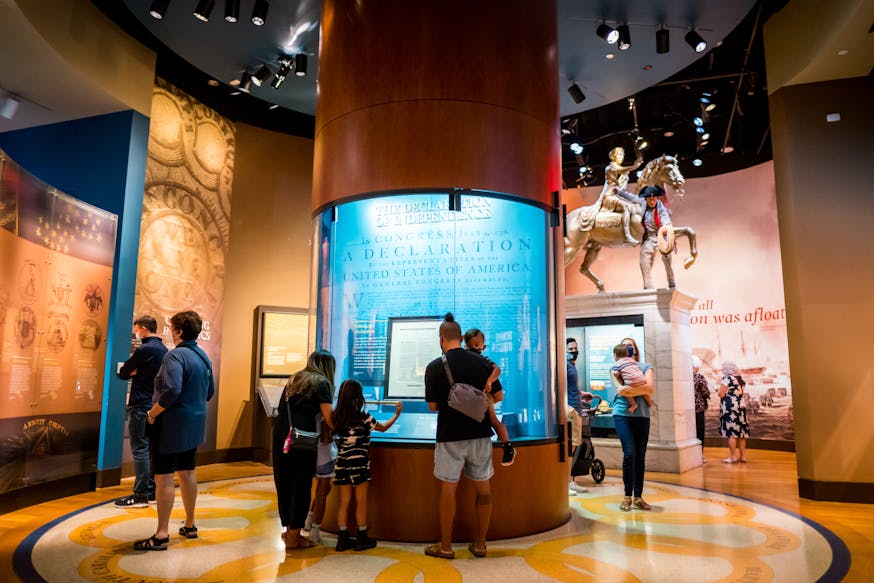
Plan Your Visit