

Read the Revolution
The Declaration in Script and Print
July 2, 2025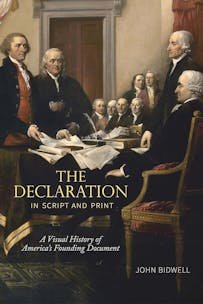
Looking up from the Museum’s main entrance on Declaration of Independence Plaza, visitors can reference this famous document’s first few lines that are inscribed:
“We hold these truths to be self-evident, that all men are created equal, that they are endowed by their Creator with certain unalienable Rights, that among these are Life, Liberty and the pursuit of Happiness.--That to secure these rights, Governments are instituted among Men, deriving their just powers from the consent of the governed...”
The Declaration was adopted by the Continental Congress on July 4, 1776, two days after Congress’ unanimous vote to declare freedom from Great Britain on July 2. Congress sent the approved document to Philadelphia printer John Dunlap, who printed 200 copies of the “Dunlap Broadside” with John Hancock’s name printed at the bottom. From this printing, Colonel John Nixon offered a public reading on July 8. The engrossed parchment, now on view at the National Archives in Washington, D.C., was signed on Aug. 2, 1776.
When was the Declaration first signed, printed, and read, and who were the artists who later published the Declaration as artworks for Americans to display at home (and sometimes in Fourth of July parades!)? In his most recent book, New York’s Morgan Library and Museum Curator Emeritus John Bidwell traces the history of prints and broadsides featuring the full text of the Declaration of Independence. Starting with a comprehensive timeline of what happened in Philadelphia in 1776, Bidwell chronicles the Declaration’s compelling visual history over the past nearly 250 years, arguing that interest in the 1800s in printing images of this text established it as an iconic document.
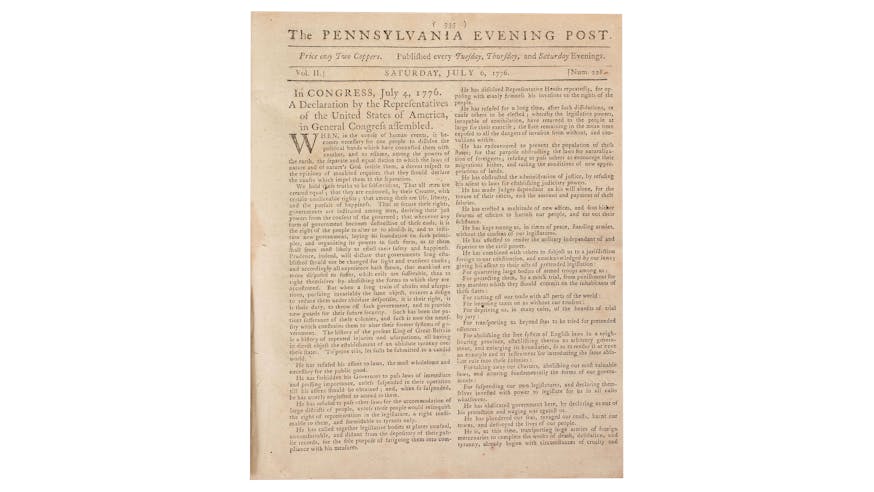
Connecting the network of authors, artists, newspapers and artistic engravings to technological advances in communication in the 1800s and the Industrial Revolution, Bidwell offers an answer to how the Declaration started its journey from American printing offices to around the world. Read the excerpt from Bidwell’s introduction to this “moving document” and learn about how two earlier newspapers illustrated the Declaration of Independence.
Related Content

Excerpt
The Declaration of Independence is the founding document of the United States. Americans have learned to cherish it and read it in different ways, depending on their political principles, their interpretation of the past, and their aspirations for the future. It is the birthright of the nation, a political testament, a social compact signed by patriots who justified a revolution. They stated their reasons in writing, in an engrossed parchment expressing their commitment and convictions. They also announced their decision in printed form, the epochal broadside dated July 4, 1776. The drama of that moment captured the public imagination, which is why we celebrate independence on the Fourth. During the nineteenth century, the national holiday could be a spectacle far more impressive than the customary concert in the bandstand, speeches in the afternoon, and fireworks at night. If the timing was right, it could galvanize an entire city and fill the streets with devotees of this iconic text.
[...]
The previous illustrated editions were negligible in comparison. Within days of the Dunlap edition, Ezekiel Russell reprinted the text in Salem, Massachusetts, with a woodcut pair of portraits. Russell may have recycled the woodcut from a previous publication, for he used it in other ventures, including almanacs, where it was captioned “The Glorious Washington and Gates,” and a broadside ballad, where it portrayed generals Washington and Ward. Its meaning in the Declaration is hard to discern unless it was supposed to represent the two officials named at the end, Hancock and Thomson. Equally obscure, a London Broadside edition contains a stipple portrait of Hancock. Issued without an imprint, it may have been produced surreptitiously by English sympathizers to the American cause. Both of these broadsides are rare, and neither attracted the attention of others in the print trade.
Bidwell, John. The Declaration in Script and Print: A Visual History of America’s Founding Document (State College: Penn State University Press, 2024), pg. 1-29.
Learn More

The Declaration’s Journey
October 18, 2025 - January 3, 2027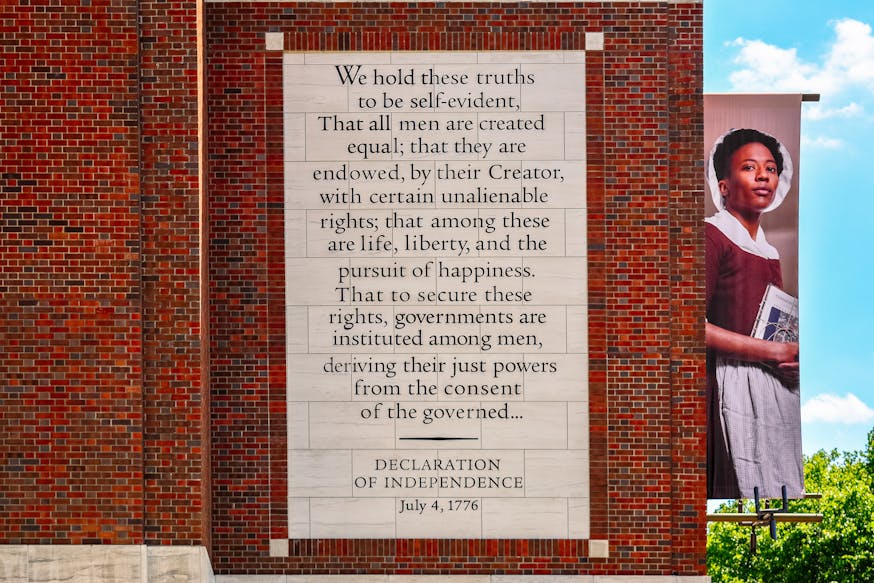
Fourth of July Week 2025 at the Museum
June 28 - July 6, 2025