

Read the Revolution
Lineage
July 29, 2025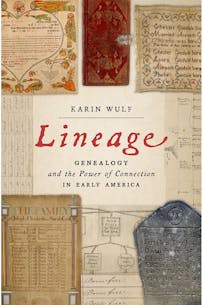
Even before the Revolutionary War, who did British Americans think their ancestors were, and how did they begin to trace their roots? For any person who has saved a birthday card, much less created (or started!) an online interactive family tree, historian Karin Wulf’s new book Lineage: Genealogy and the Power of Connection in Early America highlights how these seemingly small activities to preserve and record one’s history contribute to a centuries-old tradition of genealogy. Wulf introduces genealogy as a powerful tool that combines individual family and state interests, which was seen as “both emotionally potent and practically useful.” Lineage identifies the power people found in family ties, across the Atlantic Ocean and across economic structures and ethnic backgrounds, whether in legal court documents, town records, family Bibles, account books, needlework, or painted as heraldic symbols on carriages and ceramics. As people from different backgrounds in the American colonies determined their relationship to the Revolutionary War and to each other, they used genealogy as one guide.
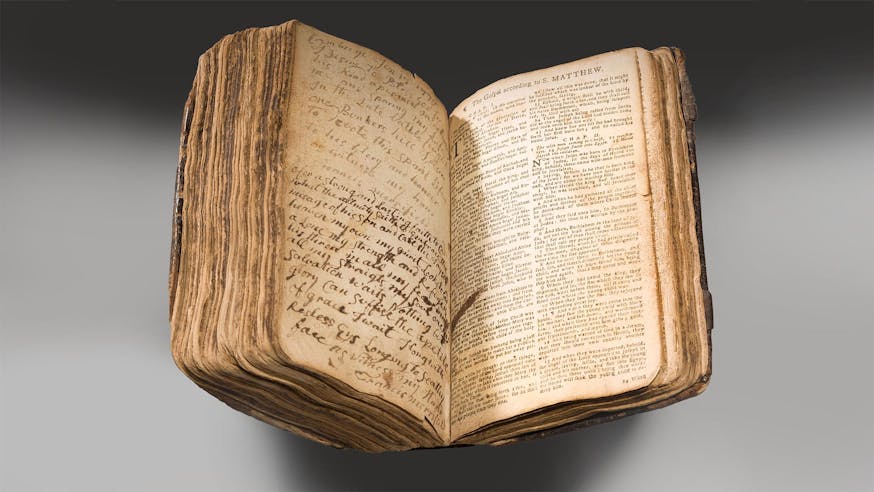
Visitors to the Museum will recognize the power of genealogy when they encounter rare artifacts with Revolutionary roots. Swords, flags, Bibles, diaries, and letters were saved by families who first treasured them as family history, thus preserving them future generations. Presenting a global historical context in Lineage, Karin Wulf offers a world of possible avenues for where people have traced historical family connections and where these traces can still be found today. She analyzes what those links meant to those who first discovered them — whether enslaved or free, 250 years ago or yesterday. How did the people who founded the United States balance the ramifications of a Revolution that dismantled hereditary authority with personal interests in their own lineages? Read an excerpt about how political leaders after the Revolutionary War grappled with their own interests in genealogy and what its expression could mean for political power in the new United States.
Related Content

Excerpt
Despite their evident enthusiasm for family histories and the energy they expended in pursuit of them, these founding-generation men and women approached genealogy with a studied public ambivalence, particularly in the later decades of the eighteenth century and into the nineteenth. When Thomas Jefferson had asked his friend Thomas Adams "to search the Herald's office for the arms of my family" he also wanted to assure Thomas Adams that he did not take their work—or the outcome of any inquiry — too seriously." That joke Jefferson had made about a coat of arms being only as valuable as any other coat was meant to show off his casual attitude, even if his actions suggested otherwise.
By the time George Washington was responding to [Sir Isaac Heard at the College of Arms] arguably the most powerful and certainly the most recognizably significant authority on genealogy in the Anglo-Atlantic world [in 1791], he had already been engaged in negotiating a freighted debate around lineage and political authority in the new nation. In the early 1780s, Washington had been burned by debates about the formation of the Society of the Cincinnati, a lineage society for officers who served in the Revolutionary War; the provision that membership was inheritable by eldest sons was particularly thorny (it did not take much imagination to make the leap to primogeniture and hereditary aristocracy). In the late 1780s, he cautioned an enthusiastic proponent of creating a public office of heraldry that some "political sentiments" still associated the new government with a plan by "the 'well-born' ...to distinguish themselves from their compatriots, and to wrest the dearest privileges from the bulk of the people."? And yet he still fussed about the way his coat of arms would appear on his carriage in 1790, wanting to be sure it was just so.
The issues with which Washington and other founders wrestled, the melded public and private recognition of lineage, were echoed across early national America. Despite, and in many respects in response to and in cooperation with, the developing discourses of democracy, meritocracy, and individualism, lineage remained a central cultural touchstone for relations of all kinds. Though the challenges to lineage were potent, so too was its appeal and apparent necessity. Historians for generations have interpreted the American Revolution as a critical transition toward a liberal society. New men, with new ideas, would, in Joyce Appleby's telling title phrase, "Inherit the Revolution." Yet what is as plain as the opportunities that new economic and political structures gave to some is the persistence of older forms of access and authority. Lineage was not a system superseded by merit—or by a natural aristocracy, pace Jefferson and Adams's famous debates — but rather a cultural form with the flexibility to adapt and persevere.
These founders embraced lineage, even as they acknowledged the inherent tensions between merit, as a means of both achievement and governance, and the significance of birth. Those tensions were reflected in print culture, where editors of newspapers and magazines published pieces discussing, debating, and referencing genealogy as a practice and lineage as a social and cultural value. Those tensions were also reflected in key areas of the law, where changes in the post-revolutionary period undercut and then reinscribed English traditions based on lineage and requiring genealogical knowledge. In early national Anglo-America, genealogy remained deeply rooted.
Wulf, Karin. Lineage: Genealogy and the Power of Connection in Early America (Oxford University Press, 2025). 247-248.
Learn More
Plan Your Visit

The Davenport Letters