



Press Releases
Museum of the American Revolution to Display Dozens of Documents Showcasing American Declaration’s International Influence in “The Declaration’s Journey”
June 30, 2025
Special Exhibition Opening Oct. 18, 2025 Will Include Rare Printings of American Declaration, Documents Related to 100-Plus Nations That Have Integrated Its Ideals
The Museum of the American Revolution today announces new details of its exhibition plans for The Declaration’s Journey – a special exhibition running from Oct. 18, 2025 through Jan. 3, 2027 commemorating the 250th anniversary of the adoption of the Declaration of Independence – related to its display of rare early printings of the Declaration and a variety of international declarations of independence issued since 1776. Those international declarations will include manuscript versions, broadsides and newspaper printings, copies, drafts, and document fragments from the 19th and 20th centuries. They contain language inspired by the Declaration of Independence of the United States and rhetoric that expanded promises of rights and equality to nations and people across the globe. These declarations have shaped our shared understanding of the world today.
Since its drafting and signing 249 years ago, the American Declaration of Independence became a model for people who wanted to change the world — to create new governments or see the spread of equality and individual freedom. It also sparked debates about who could claim its principles and guarantees, both in the United States and among populations abroad. In 1776, the Declaration needed to appeal to diverse populations in America, as well as European nations whose support the United States desperately needed to win the war against Great Britain and secure independence. Among these initial audiences for the Declaration, differing opinions emerged over the viability of the new country and the meaning of certain passages, beginning debates that in many ways are still ongoing.
Hours after the Continental Congress approved the Declaration, the first printed copies began to travel from Philadelphia to the different states, the Continental Army, and the rest of the world. The Declaration’s Journey will include several initial printings of the American Declaration, including:
A Dunlap broadside, the first official printing: When the Declaration was approved, the Continental Congress authorized John Dunlap, a Philadelphia printer, to publish the first broadsides or poster-sized copies of the Declaration. Congress sent the broadsides that Dunlap printed to each state and to George Washington, the commander of the Continental Army, as well as abroad to help forge an alliances against Great Britain. The Declaration’s Journey will feature one of only 25 original Dunlap printings that are known to exist today, on loan from The National Archives of the United Kingdom.
A Philadelphia-printed German-language broadside, the first translation: German printers in Philadelphia quickly realized the need to translate the Declaration for the more than 65,000-person ethnically German population living in and around the city in 1776. The Declaration’s Journey will feature a German-language broadside printing
sof the Declaration from July 1776, on loan from Gettysburg College Special Collections and College Archives.A rare printing from Charleston, South Carolina: It took weeks for the news of the Declaration of Independence to reach Charleston, South Carolina, which the Continental Army had defended from a British attack on June 28, 1776. The Declaration’s Journey will feature the only known surviving copy of the broadsides of the Declaration that Peter Timothy printed in Charleston in early August 1776, on loan from The Gilder Lehrman Institute of American History.
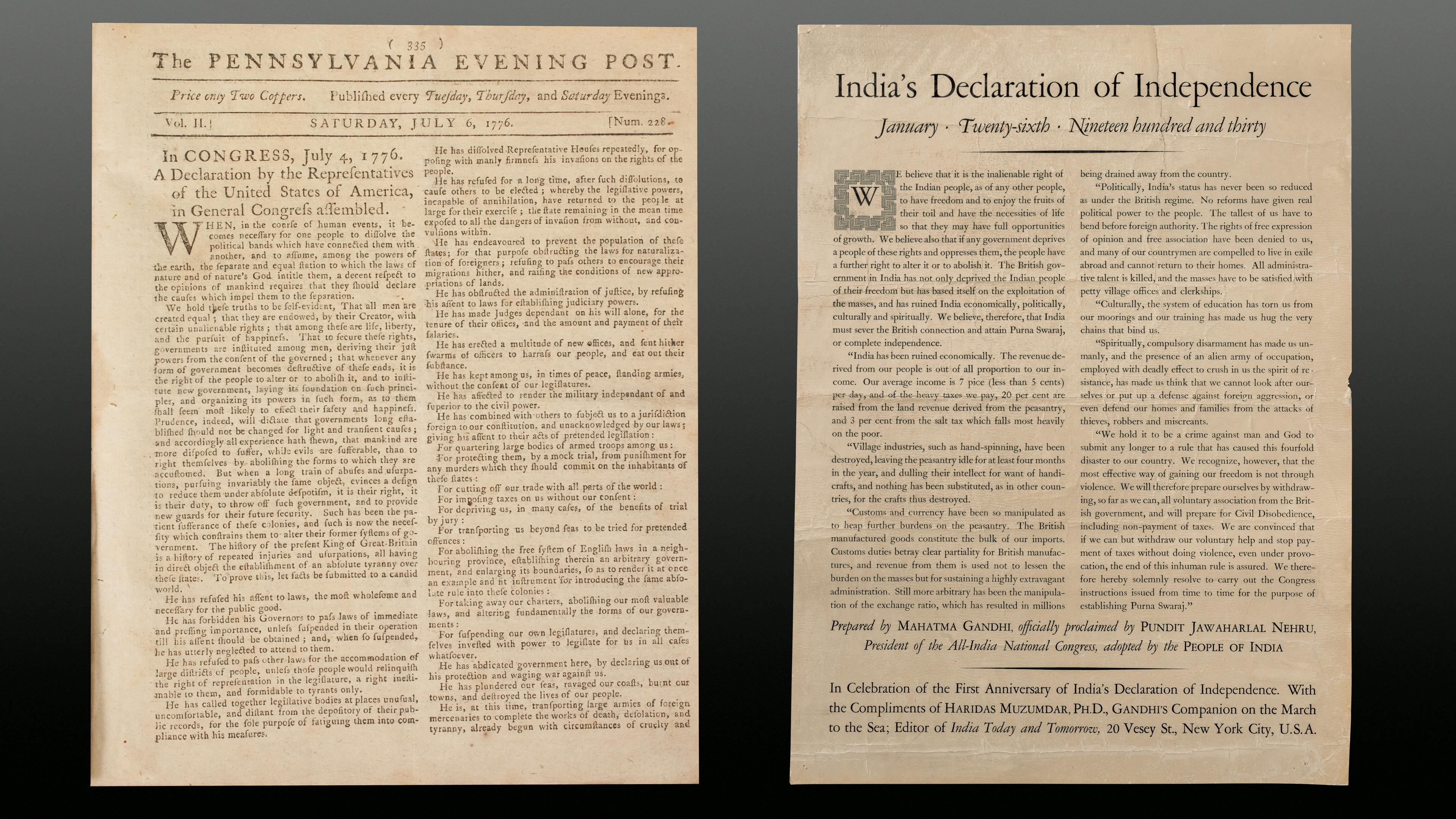
The first newspaper printing: Most newspapers in the colonies were printed once a week, but Philadelphia printer Benjamin Towne printed his Pennsylvania Evening Post three times a week. This innovative plan allowed Towne to print the Declaration in his newspaper on July 6, 1776, before any of his competitors. The Museum will display its copy of this first newspaper printing of the newly adopted Declaration as part of the exhibition.
After the United States secured independence from Great Britain in 1783, the Declaration’s journey continued in other nations and on other continents. Declarations of rights and political independence drew on the structure and concepts from the Declaration of Independence, and leaders of these movements looked to the United States for support and validation.
These revolutions reinterpreted the meaning of rights and self-government in ways that highlighted contradictions within the Declaration of Independence. As Americans had to reckon with the question of whether the equality asserted in the Declaration applied to all people, regardless of race, gender, or background.
The Declaration’s Journey will include printings, copies, drafts, and other documents related to the more than 100 nations that have integrated the ideals of the American Declaration of Independence into their own independence movements — showcasing why it is one of the most influential political documents in modern history:
Haitian Declaration of Independence (1804): In 1804, Haitian revolutionaries adopted their own declaration to break away from French colonial rule. They followed the precedent of the United States by announcing their independence, but they rejected the language of the American Declaration of Independence. Instead of an abstract equality, Haitian revolutionaries — many of whom had been enslaved and all of whom had been subjected to the racial prejudice of French rulers — declared that they would fight against their re-enslavement. The Declaration’s Journey will include a manuscript copy of the Haitian Declaration, on loan from the David M. Rubenstein Rare Book & Manuscript Library at Duke University.
Mexican Declaration of Independence (1821): The Mexican Army of the Three Guarantees brought an end to Spanish rule in Mexico in 1821. Mexico’s declaration of independence from Spain claimed that the new Mexican Empire would ensure the unalienable rights of the Mexican people to liberty and happiness. The Declaration’s Journey will include a broadside printing of the Mexican declaration, on loan from the American Philosophical Society.
Texas Declaration of Independence (1836): After Mexico adopted a new constitution in 1835, white settlers in Texas fought for the reinstatement of the old constitution, which granted certain rights, including the right to own enslaved laborers. Ultimately, they issued a declaration of independence which borrowed the structure of the United States Declaration. The majority of the signers were legal citizens of the United States. The Declaration’s Journey will include an original printing of the Texan declaration of independence, on loan from The Gilder Lehrman Institute of American History.
Proclamation of the Irish Republic (1916): This proclamation, issued during the “Easter Rising” in 1916, called for an end to the British military occupation of Ireland. Outside the General Post Office (GPO) in Dublin on April 24, 1916, Irish revolutionary Patrick Pearse read aloud the proclamation for the first time. The Declaration’s Journey will include a half-struck copy of the 1916 Proclamation of the Irish Republic that was captured by the British before its printing was completed. The half-struck copy will be on loan from The National Archives of the United Kingdom.
Indian Declaration of Independence (1930): Indian nationalists, including Mahatma Gandhi and Jawaharlal Nehru, promoted Purna Swaraj, or complete self-rule. They issued a declaration of independence in 1930 that borrowed language from the United States Declaration of Independence and stated that, when a government deprives people of their unalienable rights, “the people have a further right to alter it or to abolish it.” India secured its independence from the British Empire in 1947. The Declaration’s Journey will include a commemorative printing of the Indian declaration, on loan from the Swarthmore College Peace Collection.
“The Declaration’s Journey will recount the story of the Declaration of Independence and its global influence,” said Matthew Skic, Director of Collections and Exhibitions at the Museum. “This story also calls us to participate in and draw on the complex history of the Declaration, how its legacy now affects millions — if not billions — of peoples’ everyday lives. On the eve of our Semiquincentennial celebration as a nation, we must decide what the Declaration means for ourselves and our future.”
About Museum of the American Revolution
The Museum of the American Revolution uncovers and shares compelling stories about the diverse people and complex events that sparked America’s ongoing experiment in liberty, equality, and self-government. Through the Museum’s unmatched collection, immersive galleries, powerful theater experiences, and interactive elements, visitors gain a deeper appreciation for how this nation came to be and feel inspired to consider their role in ensuring that the promise of the American Revolution endures. Located just steps away from Independence Hall, the Museum serves as a portal to the region’s many Revolutionary sites, sparking interest, providing context, and encouraging exploration. The Museum, which opened on April 19, 2017, is an independent, non-profit, and non-partisan organization. For more information, visit www.AmRevMuseum.org or call 877.740.1776.