

About The Declaration's Journey
To mark the 250th anniversary of our nation’s founding, the Museum presents a major special exhibition exploring the history and global impact of the Declaration of Independence from 1776 to today. The Declaration’s Journey, presented by Griffin Catalyst, showcases how, with more than 100 nations having integrated its ideals into their own independence movements, the American Declaration of Independence has become one of the most influential political documents in modern history. This visually captivating exhibition gathers together for the first time in one place some of the most important and rare documents, works of art, and artifacts from around the world that reflect the complex 250-year history and legacy of the Declaration of Independence.
The Declaration’s Journey is accompanied by robust public programming for a wide range of audiences, free online educational resources for teachers and students, and a series produced in partnership with WHYY, Philadelphia’s PBS affiliate, to extend the exhibition’s national reach and impact.
The Museum is poised to play a leadership role in the upcoming 250th anniversary of the nation’s founding in 2026. We continue to transform the nation’s relationship with its Revolutionary past by increasing awareness of the many ordinary, diverse, and little-known people who created the American nation. Through this special exhibit, digital initiatives, and educational programs, we aim to facilitate widespread conversation about the meaning of the American Declaration of Independence and its ongoing legacy.
Get Tickets Member TicketsThe Declaration's First Travels

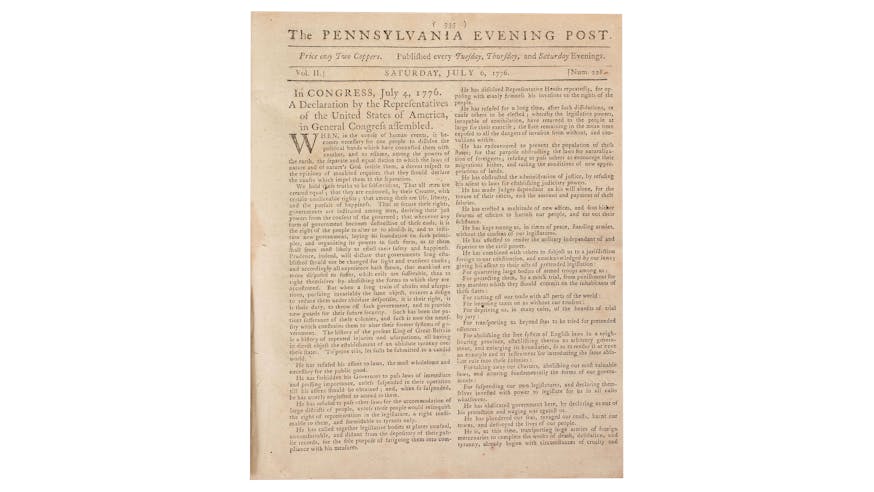
The exhibition begins with the story of Jonas Phillips, a Jewish merchant in Philadelphia who tried to send a letter, written in Judeo-German to keep its contents secret, and a John Dunlap-printed broadside of the Declaration of Independence to Amsterdam in July 1776. That copy never arrived, as the ship carrying it was captured by a British warship. The letter and Dunlap broadside will be on view alongside a discussion of Phillips’s efforts to remind government leaders about the Declaration’s promise of freedom of conscience — an early example of the emerging meanings credited to the Declaration. Other objects and documents in this introductory section convey how a July 1776 reading of the Declaration led the Mi’kmaq and Wolastoqiyik (also called Maliseet) communities of modern-day New Brunswick and Maine to enter into the first treaty to recognize the United States as an independent nation; how the French celebrated the Declaration and helped to announce the United States as a nation of the world, available for diplomacy and alliance; and how Black Americans pioneered the use of the Declaration as an egalitarian document beginning in 1776.
The Declaration in the Age of Revolutions

The story moves abroad to examine how international interpretations of the Declaration of Independence in the early 1800s pressured Americans to clarify their own understanding of the founding document, especially its language about equality. The Marquis de Lafayette borrowed language of the Declaration in his “Declaration of the Rights of Man and of the Citizen” (1789) but clarified language about equality. The Haitian Declaration of 1804, as well as the declarations adopted in Mexico and Chile, pushed and pressured Americans into conversation and conflict over the tensions within their own Declaration’s promise.
A Divided Declaration

The narrative returns to the United States, exploring the Declaration’s appropriation by abolitionists, suffragists, and Confederate secessionists. Items on display include a printing of Frederick Douglass’s oration from July 5, 1852, best known for the line “What to the American Slave, is your Fourth of July?” and a printing of the Seneca Falls Convention’s Declaration of Sentiments of 1848, which launched the modern women’s suffrage movement with the addition of the phrase “and women” to the Declaration’s statement that “all men” are created equal.
Examples of Native American declarations of sovereignty and independence, including those of the Mashpee Wampanoag and Cherokee, show ways that the Declaration’s language was re-fashioned in the 1800s by people described in the original document as “savage.”
The Declaration and the World

In the final section, visitors will encounter more and more people around the world who claimed the legacy of the Declaration. At the end of the First World War, Czechoslovakia, Korea, and six other nations adopted their versions of a declaration of independence. By the mid-1900s, the Declaration was increasingly understood as a fundamental statement of human rights and equality. Martin Luther King Jr.’s 1963 “I Have a Dream” speech is perhaps the best-known example of this understanding of the Declaration as a far-reaching promise. Visitors will leave the exhibition with an understanding of the United States Declaration as part of an ongoing revolution, a continuing effort to secure fair government and individual rights for people in the United States and around the world.
Learn More

The Declaration’s Journey
October 18, 2025 - January 3, 2027
Plan Your Visit